working with old maps

I’m still digesting the surplus of ideas, information, and stimuli that came through as overload during last week’s AAG conference in NYC.  One of the tracks that I’d have hoped to get to (if I could clone myself, and have the double arrive pre-loaded with more energy) was held at the New York Public Library, focusing on the use of historical maps and data in a number of ways.  I did have friends at those sessions, however, and one of them – Chris Gist from UVA- came to dinner one night full of enthusiasm for the plans around oldmapsonline.org.   I suppose such a wonderful level of contributed sharing was inevitable in today’s world of VGI.  Bring on the temporal/spatial change studies!

NYPL is also known for their innovative use of open-source tools to crowd source the georeferencing of their own collection of maps and images.

mapping athletic performances

My dad just forwarded me this Slate story on Kirk Goldsberry’s basketball study.  Kirk is a fellow GIS-in-higher-ed enthusiast, currently at Harvard’s GIS Center.  He presented his study at the Sloan Sports Analytics Conference; you can get a pdf of it from there too.  I love it when the popular press picks up on stories like these, as it makes the ongoing GIS awareness campaign all the more fun! Nice work, Kirk!

Kirk’s study reminded me immediately of one done by an undergrad student at St. Lawrence University several years ago. Travis Gingras, a hockey goalie and GIS intern, similarly mapped the patterns of successful hockey shots.  He won the (now defunct) Churchill Prize from NITLE for his mapping efforts.

crowd sourcing efforts in the remote sensing and spatial thinking realms

My colleague Patrick Meier tweeted about the effort to crowdsource sea floor images, evaluating the images to ascertain population counts of sea scallops.  It reminded me of similar citizen science efforts at validating land cover, and folding proteins. I remember that the Jane Goodall Institute is also contributing to or managing another forest / land cover effort too, but can’t find it right now.

Patrick has written about such efforts in the humanitarian realm as well.

It takes a village + geospatial technologies = progress.

a few examples of maps’ partial truths

One of my EDUC 616 students forwarded me this page, a collection of maps that illustrate the infamous “lying with maps” potential.  It’s a nice page for the Canadian national libraries to maintain!  Don’t overlook the “test yourself” section at the bottom; it’s a great use of maps and their histories to offer a complete mini-lesson on map interpretation pitfalls.

Aztec ruins national monument metadata

I was searching for an old map that I knew was vaguely connected with a culture from Central America, and I knew that Esri had worked on it, so I tried Google-searching for “Mayan Esri mapping” and “mesoamerica Esri mapping” and then “Aztec Esri mapping.”

I was appalled, amazed, and confused to think about an Aztec person destroying precious metadata, especially about a national monument! What were they thinking!?

Only GIS-geeks and librarians are likely to find this as amusing as I did.

observing and representing migratory patterns

I came across two sites this week that used maps in well-designed ways to visualize migratory patterns.  I have an ongoing interest in finding clever and innovative ways to represent flow and movement.

The first was Geo-Mexico, and I first saw their simple-but-elegantly-effective Flash-based maps to link individual Mexican states to the areas in the US, based on registering with consulates.  Then I remembered helping my colleague Steve to map remittances so I smiled when I saw this nice overview and a lesson to boot! I’ll definitely follow this site more. Hat tip to Seth Dixon’s Geography Education for the find.

Much more mesmerizing are these animated maps of annual bird movements, from my local-but-still-unknown Cornell Lab of Ornithology and the National Audubon Society.  I’m not a birder myself and have great respect for those who can differentiate more than from amongst crows and starlings (i.e., my skill level). I checked out the patterns of birds whose names suggested they know their home, like the Kentucky Warbler and the Louisiana Waterthrush (what’s up with that little patch in southwestern South Dakota in April/May?  a particularly active citizen-science group or an interesting modeled anomaly?).  I love how the Indigo Bunting aligns with the Mississippi in July and August.  These maps represent the results of models: they don’t reflect actual observations at all of those locations. But they do show the power of visualization when ground truthed, primary data are combined with our large collections of other geospatial information.

No man is an island, no place is a point

Rebecca Davis, my former colleague at NITLE, just hosted a Google+ discussion on possible ways that map-based stories can support student learning.  Unfortunately I wasn’t able to join them, so I’m glad that she’s posted a summary of the session.

Linking place with narrative is central for spatially-focused digital humanities efforts.  Their comments on how to make projects collaborative are particularly important ones.  The tools themselves support collaboration by design, but managing that within an instructional setting requires careful forethought and planning.  As you’re designing the assignment, think through how you may separate content from technology knowledge. Don’t leave it to chance.  Like any group project, divide and conquer through chunks or phases. Train all students with the technologies, then allow for and recognize the natural tech leaders that will come to the forefront.  Provide them structured opportunities to help their peers.  Looks for ways to customize every possible aspect of the project, from on-the-ground field work to specially designed icons. Everyone naturally gravitates towards the visual media with these tools. Don’t overlook the audio possibilities, whether it’s music associated with the project as a whole, an overall narration, or authentic voices from the people of the place.  Experiment with lines and area (polygons) as indicators of locations too. No man is an island, no place is a point.

To move beyond tacking your info over someone else’s pre-digested map may eventually require dedicated programming efforts, but I’m certain we haven’t reached the ceiling for creative projects with simple tools.

Esri has a new page dedicated to Map(ping) Stories too.

The NEH is hosting two different Institutes this summer for those with grand ideas:

1) Spatial Narrative and Deep Maps: Explorations in the Spatial Humanities, at IUPUI in Indiana, and

2) Digital Cultural Mapping: Transformative Scholarship and Teaching in the Geospatial Humanities, at UCLA.


What’s up with north on top?

The north-upness of maps is a curiosity that geographers and cartographers have perpetuated for many years, and pondered as well.  It’s interesting to think about this from the historical perspectives (like when the East prevailed) as well as the psychological outcomes of this tendency.

In my Foundations of Spatial Literacy course, we’re talking about egocentric and allocentric perspectives this week.  If you’re an iPhone user, don’t forget that you have the capability to modify your mapping perspective!   North need not always be up!  Though I do love it when I hand my phone to my kids in the car for navigating our directions and I hear their brains working to convert the perspective to whether I’m to turn right or left.  The little blue blinking dot, àla Marauder’s map, would make my top 10 favorite technological developments of the decade.

Northness is one of Kristi Alvarez’s favorite map and geography tid-bits.  More than once she teased me for being north/up-centric.  Bless your solid geographical sense, Kristi, and all of the learning that you have inspired in me. I miss you.

photographic scenes from America via Street View

Doug Rickard spent almost two years scanning through Google’s collection of “Street View” images and selected out thousands, some of which are now being shown in an exhibit at MoMA.   At first I was a bit skeptical – having “your” photos exhibited when you yourself didn’t actually create the images. You created the collection.  But the MoMA intro does explain that he mosaiced and manipulated the images, so there was creative production work on his part too. I can think of parallels with other types of artists and “found objects,” but this idea is new to me for photography.

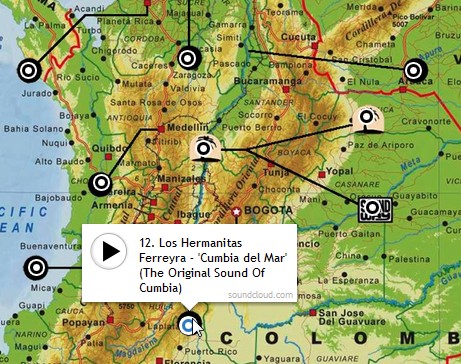
mapping cumbia in Colombia

A musical map of cumbia sources around Colombia, from Soundway Records. It’s hard to listen to these sound snippets without starting to move my feet and hips, as a dancing clod.   Colombia is my mother’s native country but I obviously inherited none of the rhythms!