the Confluence Project

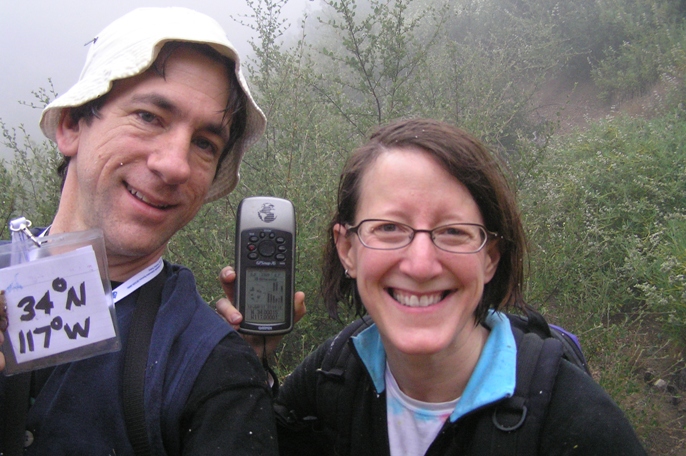
Last week I went out EARLY one morning with a friend to find 34 N latitude, 117 W longitude, contributing to the Confluence Project.  He’d been to this site multiple times, but never in a foggy rain, and we had a very memorable time scrambling over hill and dale.  For a while we had the latitude right on, then the longitude, and every time found it impossible to have one “stick” while we transversed through the dense and scrubby ceanothus to nail the other.  Our GPS trails showed that we’d clearly cross the exact site multiple times, just didn’t alight there very long!

Joseph has actually been to MANY confluence sites.  It’s a bit of a hobby-gone-wild. I love my geo-geeky friends. 


Framing geo-literacy research

For the last few days I’ve been in DC, participating in the National Geographic’s Road Map to GeoLiteracy Project.   What’s geo-literacy?  Here’s how my colleague Danny Edelson defines it – understanding how the world works, how the world is connected, and how to make reasoned decisions.  He has ambitious goals, to have a large proportion of young people develop geo-literacy competencies by 2025.

Towards these efforts, I participate as a member of the Road Map’s Education Research Group. We’ve been designing the framework for organizing our research agenda questions, likely to be grouped around our abilities to formulate geographic questions, analyze spatial variability, and construct and share accounts  of our interpretations.  We do these things as we understand our world in spatial terms.  Focusing on a K-12 project is new for me, and only infrequently do I come into contact with geography’s well-crafted National Standards.   However, our agenda reaches into higher education as well, especially as teacher preparation is concerned, and this is all highly relevant and significant for our Spatial Literacy for Educator’s program.


finding and learning through patterns

One way that spatial literacy is cultivated is the habit of observing (noting, identifying, recognizing) patterns.  Once that starts happening, they become your frames of reference.  They’re images that your mind draws upon as it makes inferences and organizes information.  Pattern, process, pattern, process.

Most geographers I know chose window seats in airplanes, even the geographers with long legs or small bladders.  Then Google Earth (and its fellow virtual globes) brought the visual exploratory experience to our desktops.  If you find yourself stuck with neither the internet nor an airplane, I highly recommend Bernhard Edmaier’s Patterns of the Earth, and Philip Ball’s Branches and Flow and Shapes. I also like to look through Gregory Dicum’s Window Seat, but I’ve never really used it while I’m flying.  I guess you could build a virtual globe lesson with it too.

Speaking of virtual globe lessons, check out Scott Wilkerson’s DELUGE project, one of the best collections of geologically-focused kml files I’ve ever come across.  He did a brilliant job of gathering and georeferencing topo maps to support 3D- and spatially-based learning.

Anyone know of other such books and resources?

roaming children, roaming cats

The LA Times hosted a health chat with Richard Louv last week, known for describing “nature deficit disorder.”  I’m a big fan of his ideas.  It’s an ongoing challenge to keep nature, in all its forms, an active part of the lives of our teenagers.  We’re in the midst of one success story: the 13- and 14-yr-old are hiking for a week with their grandparents, at the Grand Canyon and in southern Utah (Zion NP, and elsewhere).  We didn’t force them to leave their phones here, and my daughter stays remarkably aware of wi-fi zones in the hotels where they stay. But I know that at least their days are spent hiking and phone-free, and this journey with John and Wendy will certainly be a life-long memory for them.  If they just survive the 24-hrs/day they’re spending with each other right now…

And look, even cats know the fun of roaming outdoors.

Stop reading this blog. Go outside and walk around the block, or if you’re lucky, up in the woods.

Thanks, Janet, for the hat tip on Louv’s interview.

Exploring migration mapping

Wondering what’s been happening at Redlands lately?  This week we’ve been immersed in discussions about mapping migrations.  It’s the central point of our 2011 LENS activities, a 4-day Mapping Migrations Institute in which we immerse ourselves in conceptual, technical, cartographic, and pedagogic issues of migration and their representations.  It’s been both heady and sweet.

I’m too beat tonight to share details, but I’ll share the highlights soon.  Meanwhile, if anyone has some great examples of migratory mapping, or questions they want to throw our way, send them on.

stop life for a minute and catch your breath

I’m finding my life a bit overwhelming lately, with way too much happening and too many unanticipated things to manage.  Yet somehow I’ll get through it all, and I’ll survive, literally, and these days too will seem like a blur.

Then what’s left at the end of the day (week, year, life) is fragmented memories that you piece together.  I’ve been watching this video clip on life’s moments that my friend Theresa shared with me.  And listening non-stop to the new album Rome by Danger Mouse & Daniele Luppi.   And loving them both.

another Google way of visualizing earthquake distributions

Monitoring earthquake occurrences and studying their patterns is a persistent pastime for residents of Southern California.  I really like this Google tool (new to me) called ninepointfive.org.   The default “particle” view is a little weird, but when I switched it to the more familiar “rings” format, it all became much clearer to me.  It takes a little time to load the long lists from previous years, but all seems to work well when I’m patient for a few seconds (an eternity in today’s cyberspace).

Mapping and Classifying Your Every Move: Quotidian Habits

The location-enabled form of navel-gazing.  Wear a GPS  for 200 days and then categorize all of your activities.  Someone has a lot of time on their hands…  But from an anthropological perspective, I appreciate the curiosity of it – http://www.tlclark.com/atlasofthehabitual/index.html.

Cultivating Graphicacy While Teaching GIS?

There’s a side to working with maps and data that’s easy to overlook when we design our courses, and it falls under the heading of graphicacy.  My own quick definition of graphicacy is making, interpreting and critiquing of information in non-text form, including graphs, tables, figures, charts, AND MAPS.   I can’t remember first learning the word, but this Aldrich and Shepphard article (pdf) was one of the first that explained the concept.

I’ve come to strongly believe that graphicacy is a necessary and essential component of education.  One of the obvious reasons is how much we’re confronted with information in graphical form, such as this world population map from The Economist or the New York Times recent map of tornadoes and other natural disasters.  A good sense of graphicacy means that you are critical and creative with data, know when to question a representation, can envision alternative representations, can interpret the information and articulate its message.

The use of GIS presents numerous opportunities to develop strong graphicacy skills, but it’s definitely not an automatic outcome.  It includes the classification of data, and the cartographic design of layouts, but it goes well beyond that. It’s fundamental to how we expect to communicate with the rest of the world about what a GIS analyses means.  It’s not something that’s a separate topic to be added to a GIS course. It’s an understanding that needs to be cultivated throughout, in every lab and exercise that a student completes, and in every mapped representation that they create and encounter.  It’s the understanding of how maps complement and support learning on many levels.

new infographics-based weather site

My favorite new site for info graphics?  Weatherspark.  Possible to spend a focused moment learning the current and relevant, or a sprawled hour reminding yourself of that blizzard four years ago that disrupted your life.  Brilliant access to data.  Nice work, Jacob and James.