Steinitz’s book on Geodesign makes its appearance

Carl Steinitz has been working on his geodesign framework ideas for many years. They’ve come together in his new publication, A Framework for Geodesign: Changing Geography by Design.

Check out this book if you’re interested in how geospatial technologies can inform the design process, and vice versa. Lots of good nuggets of knowledge here. And it’s so well-edited too!

Naming streets, counting citizens, and mapping facilities = Empowered improvements

A NYT story about students from Harvard documenting locations and types of toilets available in a Mumbai slum.

“The act of naming streets, counting citizens and mapping facilities turns information into an advocacy tool.”

But what was unexpected, that using toilets lowered some rates of sickness, or that even the poorest of people would pay 2-3 cents to enjoy a cleaner site?

How would you define spatial literacy?

I’m always curious about course descriptions whose titles have “spatial literacy” in them, including this one called Introduction to Spatial Literacy and Online Mapping, offered by the Reference and user Services Association, part of the American Library Association.  I’m not sure what their descriptions of “geographic literacy” are, but it seems to be GIS and mapping-focused.

I’ve worked hard on a working definition of spatial literacy that isn’t only geographically-focused.  Spatial literacy is the competent and confident use of maps, mapping, and spatial thinking to address ideas, situations, and problems within daily life, society, and the world around us.

Why is this definition robust enough for me? Because “maps” don’t have to be geographical ones. Concept mapping is hugely spatial, or generating any arrangement of information.

and what’s spatial thinking?

Spatial thinking is the ability to visualize and interpret location, distance, direction, relationships, change, and movement over space. 

Location is absolute and relative, discrete and continuous, metric and abstract. It can be fixed – like our perception of where a monument is located – or floating – like where a cloud lies in the sky at a given moment. It can be geographic – where the line of forest meets a field – or spatially conceptual – where a stack of blocks sits on a computer screen.

spatial vs. geography, in so many words

The differences between “spatial” and “geography” are interesting to me, and not trivial, usually. I’ve definitely noticed the expansion of the use of the word “spatial” overall. When it was part of my dissertation title in 1996, I know it wasn’t nearly as wide-spread as it is now. Here’s a graph that the Spatial Information Management blog created for spatial vs. geographic terms in books, an Ngram. Interesting, for sure. I recreated it for American English (1800-2008) and British English (1800-2008).  Not sure why just “English” has a downturn starting at the year 2000.

Capitalizing the words makes a big difference (here’s British English for Spatial and Geography), so does that mean that titles are involved?  I also like the spikes for the early 20th century American English, when academic Geography in the US was at its peak too.

One project (for my next pocket of spare time, hah) is to scan the titles and abstracts of journal articles from many disciplines over the last 150+ years and see when this “spatial turn” really began, in an academic sense.

another look at group differences at navigation: Europeans and Americans

This Atlantic article reports on a recent study looking at strategies used for direction-giving. Americans rely more on cardinal directions and street names; Dutch on landmarks and vistas.  In general, it’s also women who use landmarks more, men who turn to cardinal directions and measured distances.

I always wanted to do a study in a small town where I used to live, where people were more likely to shop at a grocery store in a small city 12 miles to the north versus a grocery store in another small city 11 miles to the south. One difference is that the northern route was flat, the southern one was very hilly and steep. Perceptions of effort?

new examples of geographically-informed art

Some lovely and gentle hand-drawn maps from Emily Robertson, followed by some woodcut ones via Bob Vila.

Maps of the United States shapes comprised of their bird feathers, by kelzuki on esty, and maps shaping other forms and objects, by Matt Cusick.

Finally, some philosophical thoughts linked to inspirational images, by Maptia.

ideas at EdUC: spatial thinking, open educational resources, ArcGIS Online

Day 1 of the 2012 Esri GIS Educational Conference begins shortly. Yours truly will have the honor of speaking on the stage with my colleague, Joseph Kerski. Since I was privy to the other plenaries at our rehearsal yesterday, I know you’ll hear the phrase “spatial thinking” in almost everyone’s presentation, and ArcGIS Online will figure prominently this year as well.

JJK and I will be talking about “open educational resources.”  Open is a word that can be construed in many ways, and that’s okay. Such definitions are not always mutually exclusive. I’ll be using “open” as both an adjective and a verb, like my friend Jeremy Crampton does too. I look forward to the lively discussion.


Considering Spatial Citizenship

I’ve just completed Day 1 of a SPACIT meeting, the semi-annual gathering of partners working on this Comenius funded project. Very interesting ideas coupled with very ambitious plans! Combining GIS&T, geography, philosophy, politics, the act of “participating” – or engagement, pedagogy and teacher professional development, communication, and other technology, especially via geomedia. Here’s a recent paper, GI and Spatial Citizenship (pdf) authored by 3 of the lead partners, Inga Gryl, Thomas Jekel, and Karl Donert.

I’m contributing on behalf of NCGE, and I have much to learn from these discussions. And did I mention we’ve gathered in Salzburg, Austria, at the university where the GI Forum and AGIT is about to happen?  Geo everywhere.

Save the Date – GIS & Spatial Thinking in College conference at Bucknell in November

Bucknell University will be hosting a weekend conference on GIS / Spatial Thinking in mid-November.  A call for participation was announced today. Too bad we’ll have to make choices about session attendance, as I’d like to learn from all of them!

My keynote is likely to focus on the issues of GIS as perceived from the administration and highers-up, and managing GIS and its opportunities (and strengths, weaknesses, and threats!).

new discovery: Jerry’s map, all 50 years and 2500 plates

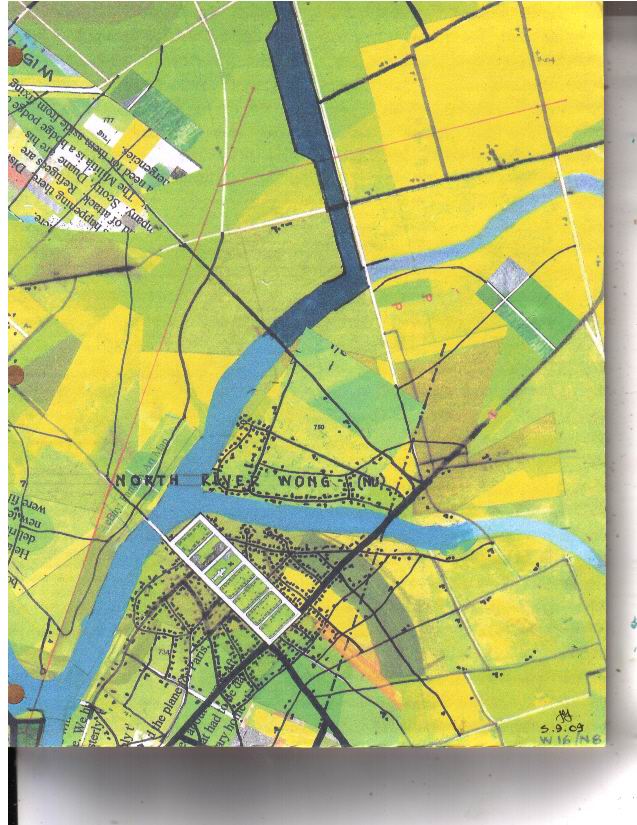
I’m sorry I can’t find the first link that directed me to this, but today I took a look at a site I’d tagged to revisit, Jerry’s Map.  I’m loving it. Only map-making, geodesign-inspired, cartographically-motivated, color-exhilarated people might watch all 10+ minutes of his story, on video. Me?  I’m going to watch it again.

I love how he lets the cards direct his movements, and how he’s realized how the combinations from non-adjacent tiles are just as beautiful as art, and how he manages to find his balance between following spatially-autocorrelated rules and taking artistic liberties.