
national poetry month, exploring through maps

April is National Poetry Month. (Sure, why not? It has to be sometime, if we can’t have National Poetry Day year-round!)  There are several map-using-poetry-sites I’ve become aware of lately, including:

  1.  Places of Poems and Poets (part of an online poetry collection done by the libraries at the University of Toronto)
  2. Poetry Atlas (created/maintained by Tam Tam, a media company in the UK)
  3. a National Poetry Map, from poets.org
  4. a World Poetry Map, focusing on poets representing scarce-spoken languages, funded by the NEA and others.  (Is that really the dividing line between Europe and Asia? Really?)

Basically these are all mashups with point locations that document an author’s birthplace or native state/country, or maybe the landscape about which the poem is based, etc.  Simple geocoding or geotagging has taken place. So in every case the maps are simply an organizational template for the poems,  not something that necessarily give any new insights.

What would be even better?  A site that uses other geographical “filters” to discover poems.  That is, show me poems about waterfalls AND show me the images of where those waterfalls are.  Or, if it’s a poem about a gritty urban scene, show me some gritty urban scenes.  A poem about a historical time at a particular place?  How about linking it to HistoryPin or WhatWasThere?

And while we’re at it, how about a little audio, people?  Reading poetry is terrific, but I love listening to it too.  It’s easy to record someone reading a poem and link to that recording in the placemark.  It could even be done in native tongue and then a translation.  And, while you’re at it, how about with the sound of waterfalls in the background too?

If anyone knows any sites that creatively uses poetry and maps, please share them.

h/t to Google Maps Mania for some of the sites.
diving right into participatory mapping

A recent blog entry by my friend Meg Stewart reminded me of the work that Aly DeGraff is doing in the Grenadines.  I remember hearing about Aly a few years ago. We both went to Middlebury College (go Panthers!), where colleagues of mine in the geography department talked about her skills and motivation as she went through her years there.

Aly is now finishing up her year-long program of participatory mapping in the Grenadines.  After catching up on her blog entries, I just have to say that I’m really impressed with the focus, professionalism, and confidence with which she’s pursuing this work. I haven’t done much mapping of this type myself, but my little forays as part of projects and workshops over the years have clearly shown me that one must accept the process even more than the product as a metric of success.  I also know that I *never* could have done this type of work on my own at that age, even with the help of a mentor.  Kudos to the Compton Foundation for funding these projects.  Go, Aly, go!

Projects like these also remind me of geodesign processes, which I’ve thought a lot more about in the last year since I helped to edit Carl Steinitz’s forthcoming Esri Press book on A Framework for Geodesign.  Participation from “the people of the place” are a defining characteristic of geodesign, and how that’s implemented looks different in every situation. The case studies in Carl’s book range along a spectrum of size and scale, but all involved larger support teams than Aly’s work.  Another reason which I find her progress so enjoyable and remarkable.

using memory and imagery to get kids to think about “place”

The last assignment for my EDUC 616 students has been to create their own “When I Was 10” maps.  I always use that age based on the the ideas about the geographies of childhood, inspired by the guidance of Edith Cobb (The Ecology of Imagination in Childhood) and Gary Nabhan and Stephen Trimble (The Geography of Childhood / Why Children Need Wild Places).  Basically, the age around 5th grade, more or less.

My students are making digital or paper versions of their maps.  They’ll likely all use planar perspectives, though in other versions of this assignment I’ve stipulated that students *must* include elements drawn from additional (oblique, frontal) perspectives as well.  Here’s a simple one on Flickr where the mapmaker used transparent areas to indicate location, then annotated.

In the digital world, we can jump down to street view for an immediate frontal perspective.  Here’s a website for a childhood walk that had the idea for narrated descriptions of such places.  Esri is promoting the idea of “story maps too;” their ideas here can readily adapted for youth-oriented projects.

mesmerizing wind map of the lower 48 states

I’d like to make this my screen saver.  http://hint.fm/wind/

h/t to many on Twitter, including @ajturner and @mrgeog.

Happy to have stumbled across GIS Stack Exchange

New to me: GIS Stack Exchange. A great site for questions, answers, and thoughtful discussions!

maps, mapping, humor

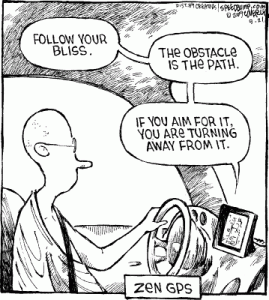
I wandered across a fun mapping and GIS blog recently, Blue Sky GIS.  They’ve collected (and generated) some fine ones, like this:


Volunteer for crisis mapping efforts

The Standby Task Force is a volunteer-based network that provides real-time crisis mapping support for humanitarian organizations.  It emerged after the International Crisis Mapping Conference in 2010 and now has hundreds of members from around the world, people who participate in deployments once a call for help is received.  The SBTF is comprised of teams that monitor and translate stories from media sites; generate and verify reports; geolocate incidents; and analyze patterns of events, among other tasks.  Together with my colleague Helena Puig, I help to coordinate and guide the volunteers on the Analysis Team.  Here’s Helena doing a webinar that talks about the analysis team’s activities. Typically a deployment is only for a few weeks or up to a month, until others on the ground are in a better position to take over coordination and relief efforts.

The SBTF practices with simulations, and there’s one coming up next month in Boston.  It’s not too late to get involved!

alternative ways of grouping and describing Americans

A post from somewhere recently (the Atlantic?) keyed me into the work done by John Nelson at IDV User Experience, such as Thiessen polygons of Craig’s Lists boundaries.  Then I wandered onto a similar approach for Massachusett’s Dunkin Donuts regions by PasteInPlace.   Soon the indefatigable Seth Dixon had pointed me towards the US Personality map. Next thing I knew, I was back to John Nelson’s production of the US according to its Google Autocompletes.  (Which reminded me of the Google Making us Dumber site, which I see has become stale, or maybe it was this Oddee list I was remembering.)

Just a few bookmarks after a Sunday night hour of procrastination…

spatial thinking making its way into popular media

Slowly but surely, the ideas and understanding about spatial thinking (cognition, intelligence, abilities, skills, literacy, habits of mind, etc.;  You name it, it’s relevant and connected) are making their way out of the academic file cabinets and into circles of more common knowledge.  Earlier this week a colleague of mine from Esri (Tom Baker, @trbaker) forwarded this around, a Psychology Today article about our undervaluing of spatial intelligence.   It was written by Jonathan Wai (@JonathanLWai), a psychologist whose work I first became familiar with through a National Science Board publication (2010) on Preparing the Next Generation of STEM Innovators.

These documents identify the need to seek out under-recognized spatial talent in order to avoid missing the top fraction of those who would otherwise excel. But I firmly believe that it’s an overlooked component of all education, for all students.

University of Redlands students shining in their spatial literacy course

I want to send a shout out to all of my EDUC 616 students this weekend.  I’m grading recent assignments and I am SO PROUD of what you’ve learned over the last two months!  You guys rock!  I just need to step out of the way and let you emerging educators take over.   Really nice work.