What’s my new job?

Since the summer, I have been working for UCGIS, the University Consortium for Geographic Information Science, as their Executive Director.  Translation: I manage the business-related operations of a small non-profit that’s focused on advancing and supporting the research and education ideas of the GIS-teaching faculty at its 50+ member institutions.  Today, Directions Magazine printed an interview I did with them about UCGIS and some of its upcoming activities.  And, it’s International GIS Day! Woo-hoo!

Maps as Organizational Templates

There’s a hip trend going around, making simple maps with labeled spaces. At least one or two a week have been crossing my computer screen lately. I’ve always referred to this approach as using maps as organizational templates. In most cases the map-makers don’t go into telling a story about why the data are where they are. They’re just labeling a place with its information, and leaving the rest up to us. The map is serving as a way to represent data by virtue of its geographical location. That is, we start with some data, and that data happens to have a 1-to-1 relationship with some location, like a state in the US, or a country in the world.

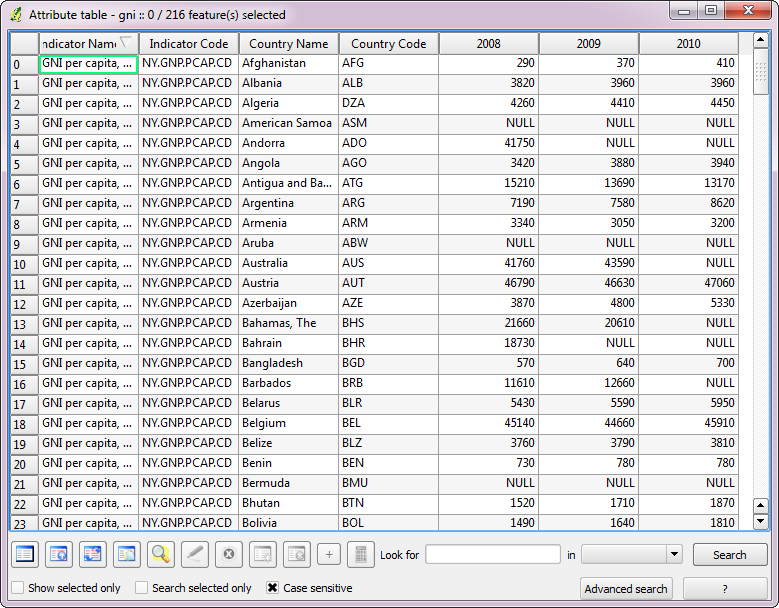
We could use a spreadsheet as an organizational template instead. In fact, many of these maps started that way. Start with a spreadsheet with an alphabetical list of all 50 states (plus D.C., which often gets overlooked), and then another column in the spreadsheet has some information about each state (let’s call it an “attribute” of that State).  And maybe we know different attributes for different years.

Problem: looking at an Excel spreadsheet is boring. And it’s virtually impossible for us to envision a “pattern” from a spreadsheet. States or countries arranged alphabetically tells us nothing about the geospatial relationships among those places. Did I already mention it’s boring. Our eyes glaze over. Who wants to have glazed eyes?
Instead, by labeling each state – or country – or region – with the attribute, we can appreciate the geographic pattern of said information.  When the data are categorical or nominal, you might get a map like what the most popular boy’s name has been in each state over the last 60 years, or the girls’ names, or surnames in Europe, how the Russian language engenders the names of world countries, or what each world country is “best at” (which is a wonderfully subjective way to begin a discussion), with the label being a word or a phrase.

Such data can often be represented pictorially or through icons, like the “most famous book” in each State (again, who gets to decide that?!), or the Food of the States. At least they remembered D.C.!

I don’t know, maybe it’s just me. But I’m seeing these maps all over the place these days.

new article linking spatial thinking with multiple school topics

Temple University’s Nora Newcombe is well-versed at writing about spatial thinking in a way that makes the topic accessible to lay audiences. New to me: a piece called Seeing Relationships (pdf) in the Spring 2013 American Educator. Now she can share the results of the large meta-analysis recently completed, that documents our mind’s capacity to become more skilled at spatial tasks.  She’s still firmly grounded in her own disciplinary perspective, cognitive psychology, but here she ventures into examples involving geographic space and geospatial technologies, not only mental rotation in abstract space. This piece includes call-outs to the Geospatial Semester program at James Madison University and Stanford’s Orbis project.

Nora’s oft-cited, oft-shared 2010 American Educator piece, Picture This, is still available too.

model for professional development at UVM

In the College of Arts & Sciences at the University of Vermont, faculty are involved with a year-long initiative to learn more about maps and mapping. I had a chance to be part of their August 2013 workshop and share ideas about teaching and learning supported with geospatial technologies. Members of the department of geography are leading this effort, and though they’re disciplinary experts in this field, they themselves are learning from the new perspectives and novel projects being designed and developed.  A way to spread opportunities for spatial analysis and geographical inquiry.

shadows and mirrors in Norwegian town

One small Norwegian town is geographically plagued by its position in a valley, leading to topographically-induced shading during its otherwise already dim winter days.  An attempt at a targeted solution?  Mirrors strategically placed.

Good luck to them!  I love that it combines the best of geographical AND spatial thinking, or spatial thinking in situ. That’s also called geodesign.


Documenting Slum Space in Kenya

A great story this morning on NPR about mapping projects in urban slum areas of Kenya, both involving collecting data on roads, housing, community structures, open spaces, and where people are conducting their activities of daily life.  One project using GPS, the other traced over a satellite image to make a draft map.  I liked how he referred to the “rectangles” of houses; as he said that, my mind instantly translated to “polygons.”  Like those instantaneous translators working at the United Nations.

The story made for a driveway moment for me.  So great to have these mapping stories becoming more common.

visualize El Capitan’s geology through swiping

I love it when somebody manages to collect original data of something that we’ve all seen before, with new details and insights.  This swipe-enabled image of the geology of El Capitan in Yosemite National Park is terrific.

h/t Neotorama

new Holocaust Geography site

I’ve been following the various projects that research the Holocaust through its geography, often using GIS.  I’m most familiar with the work of Anne Knowles (video), connected in one part to the Spatial History project at Stanford.   The US Holocaust Memorial Museum also maintains a collection of geographically-based exhibits.

Today I learned about a new site, Exploring the Vilnius Ghetto.  The map interface is the standard organization framework to arrange geotagged media. Nicely designed.

H/t to Heather King.

photo collection from Yap

Some of the photos organized into an album here.  I understood photo sharing better via Picasa, not sure about this whole Google Plus thing.  Oh well, my life is online.

Still to come: a video and map story just about stone money.

sunsets and full moons in the rear view mirror

Three weeks of time shifting. How can it all drag out so slowly and fly by at the same time?  We’re heading to the airport shortly, for our  4:10 am flight to Guam. Who schedules a flight for 4:10 am?

I’ve been watching chickens cross the road. The full moon brings the crabs out, and they’re running across the roads too. The full moon makes the neighbor’s yard flood with the tide is high, twice daily.  Now it happens only every four weeks when moons are full. Soon it will happen more and more regularly since they live only inches above sea level.  Today we had one light drizzle rain, during the local 8th grade graduation ceremony that we were watching, and two strong and heavy downpours, each an hour apart while we were riding in the back of the pickup truck on two separate occasions. I usually ride up in the cab; professor’s privilege. Tonight I was in the back both times, together with students and fellow professor Greg, and both times we were absolutely drenched with rain. We howled with laughter.

I’ve loved Yap, especially being called by my first name now by a few dozen people on the island, and experiencing underwater life through scuba and snorkeling, and making maps for the Yapese.  Someday I’ll come back.