Category Archives: GIS

Mapping People Symposium: October 31 at Univ of Redlands

We’re gearing up for our first (annual?) Symposium on Mapping People.  Join us for this one-day event on October 31. We’ll explore the joys and challenges of mapping social and cultural data, learning about innovative approaches and projects.  Ian Gregory will be our keynote speaker. We’re seeking submissions of abstracts for lightning talks and posters.  Awards will be given for the top grad student and undergrad student presentations!

The event is free, sponsored through our grant from the W. M. Keck Foundation.  But space is limited so register soon!

ideas at EdUC: spatial thinking, open educational resources, ArcGIS Online

Day 1 of the 2012 Esri GIS Educational Conference begins shortly. Yours truly will have the honor of speaking on the stage with my colleague, Joseph Kerski. Since I was privy to the other plenaries at our rehearsal yesterday, I know you’ll hear the phrase “spatial thinking” in almost everyone’s presentation, and ArcGIS Online will figure prominently this year as well.

JJK and I will be talking about “open educational resources.”  Open is a word that can be construed in many ways, and that’s okay. Such definitions are not always mutually exclusive. I’ll be using “open” as both an adjective and a verb, like my friend Jeremy Crampton does too. I look forward to the lively discussion.


Considering Spatial Citizenship

I’ve just completed Day 1 of a SPACIT meeting, the semi-annual gathering of partners working on this Comenius funded project. Very interesting ideas coupled with very ambitious plans! Combining GIS&T, geography, philosophy, politics, the act of “participating” – or engagement, pedagogy and teacher professional development, communication, and other technology, especially via geomedia. Here’s a recent paper, GI and Spatial Citizenship (pdf) authored by 3 of the lead partners, Inga Gryl, Thomas Jekel, and Karl Donert.

I’m contributing on behalf of NCGE, and I have much to learn from these discussions. And did I mention we’ve gathered in Salzburg, Austria, at the university where the GI Forum and AGIT is about to happen?  Geo everywhere.

Save the Date – GIS & Spatial Thinking in College conference at Bucknell in November

Bucknell University will be hosting a weekend conference on GIS / Spatial Thinking in mid-November.  A call for participation was announced today. Too bad we’ll have to make choices about session attendance, as I’d like to learn from all of them!

My keynote is likely to focus on the issues of GIS as perceived from the administration and highers-up, and managing GIS and its opportunities (and strengths, weaknesses, and threats!).

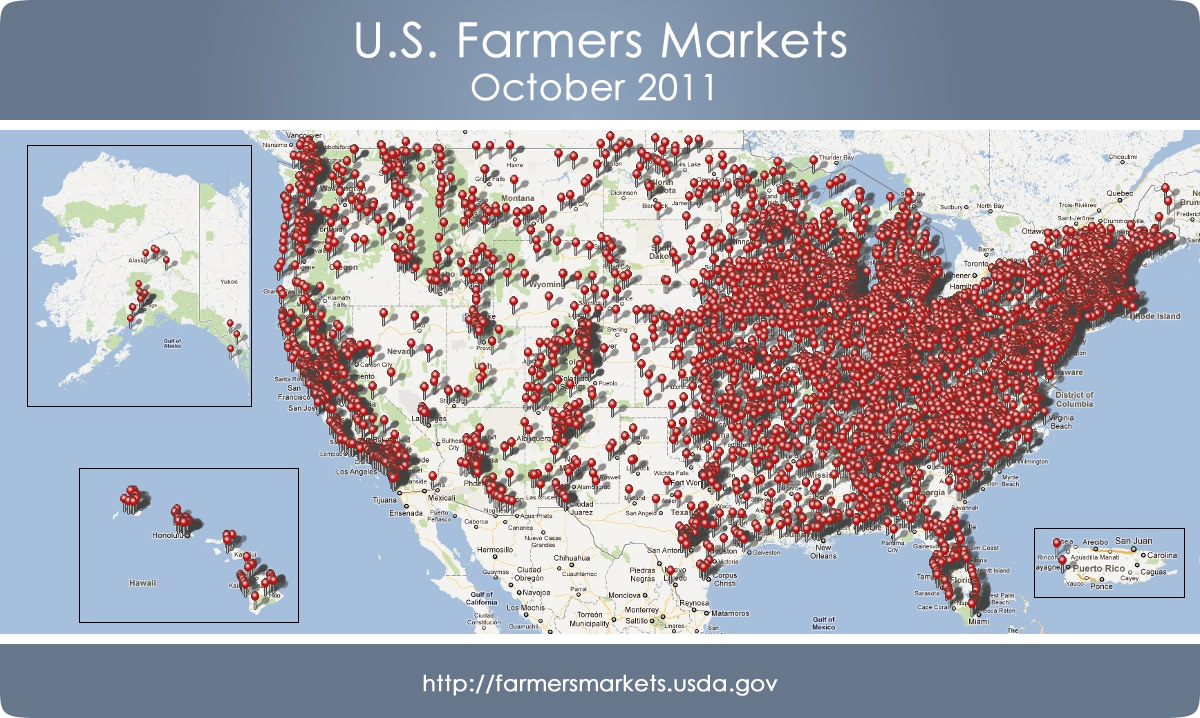
data for mapping farmers’ markets

During a workshop today, I came across this USDA collection of data for farmers’ markets.  Easy to download, easy to map.  Don’t know how currently or accurately it’s maintained, but it’s enough to start with!   Somewhere this mashup image was already part of it too.

exploring tornado analyses and data

It’s that time of year, when small towns in the Midwest make headline news for the trailers that get upturned.  One of my favorite data visualization referatory sites, ChartPorn (unfortunate name, guys) , recently posted an overview of maps and data analysis sites for info back into the mid 20th century. I explored one of these sites further and came across NOAA’s National Weather Service’s Storm Prediction Center.  This is a nice collection of GIS-ready data for those of you who want to make your own maps.

Happy to have stumbled across GIS Stack Exchange

New to me: GIS Stack Exchange. A great site for questions, answers, and thoughtful discussions!

mapping athletic performances

My dad just forwarded me this Slate story on Kirk Goldsberry’s basketball study.  Kirk is a fellow GIS-in-higher-ed enthusiast, currently at Harvard’s GIS Center.  He presented his study at the Sloan Sports Analytics Conference; you can get a pdf of it from there too.  I love it when the popular press picks up on stories like these, as it makes the ongoing GIS awareness campaign all the more fun! Nice work, Kirk!

Kirk’s study reminded me immediately of one done by an undergrad student at St. Lawrence University several years ago. Travis Gingras, a hockey goalie and GIS intern, similarly mapped the patterns of successful hockey shots.  He won the (now defunct) Churchill Prize from NITLE for his mapping efforts.

crowd sourcing efforts in the remote sensing and spatial thinking realms

My colleague Patrick Meier tweeted about the effort to crowdsource sea floor images, evaluating the images to ascertain population counts of sea scallops.  It reminded me of similar citizen science efforts at validating land cover, and folding proteins. I remember that the Jane Goodall Institute is also contributing to or managing another forest / land cover effort too, but can’t find it right now.

Patrick has written about such efforts in the humanitarian realm as well.

It takes a village + geospatial technologies = progress.

No man is an island, no place is a point

Rebecca Davis, my former colleague at NITLE, just hosted a Google+ discussion on possible ways that map-based stories can support student learning.  Unfortunately I wasn’t able to join them, so I’m glad that she’s posted a summary of the session.

Linking place with narrative is central for spatially-focused digital humanities efforts.  Their comments on how to make projects collaborative are particularly important ones.  The tools themselves support collaboration by design, but managing that within an instructional setting requires careful forethought and planning.  As you’re designing the assignment, think through how you may separate content from technology knowledge. Don’t leave it to chance.  Like any group project, divide and conquer through chunks or phases. Train all students with the technologies, then allow for and recognize the natural tech leaders that will come to the forefront.  Provide them structured opportunities to help their peers.  Looks for ways to customize every possible aspect of the project, from on-the-ground field work to specially designed icons. Everyone naturally gravitates towards the visual media with these tools. Don’t overlook the audio possibilities, whether it’s music associated with the project as a whole, an overall narration, or authentic voices from the people of the place.  Experiment with lines and area (polygons) as indicators of locations too. No man is an island, no place is a point.

To move beyond tacking your info over someone else’s pre-digested map may eventually require dedicated programming efforts, but I’m certain we haven’t reached the ceiling for creative projects with simple tools.

Esri has a new page dedicated to Map(ping) Stories too.

The NEH is hosting two different Institutes this summer for those with grand ideas:

1) Spatial Narrative and Deep Maps: Explorations in the Spatial Humanities, at IUPUI in Indiana, and

2) Digital Cultural Mapping: Transformative Scholarship and Teaching in the Geospatial Humanities, at UCLA.