Category Archives: maps

more examples of linking geography and history via maps, some digital

My friends at the UVa Scholar’s Lab shared with me their new Neatline project earlier this week. I don’t know much about Omeka, but I always trust these guys to do good work with a wide range of OS tools. I do like the interface, the rapid loading of georeferenced maps, and the additional interactive functionality on the main screen. If I can figure out more about this, I have a stack of projects ready to try!

In Time & Place is oriented to secondary school learning. This will be a good resource for my Spatial Literacy students, and I’ll see about modifying things for my higher ed students too.  Not sure how I wandered across this site this week. I need to click on fewer windows to make h/t’ipping easier.

Conflict History is a Google Maps mashup. I like the timeline and the thorough “info” available.  This interface and collection really highlights the disparity between how few military conflicts we’ve had on US soil versus the rest of the world, and how relatively high Europe and Asia are. Not news, but interesting to see it in this way.  H/t to Google Maps Mania.


Connections between hazard mapping and outcomes

Time Magazine reports on a study (pdf) that considers the connections between hazard maps and recent natural disasters.  Are “bad maps” to blame for greater-than-expected damage, death, and destruction?  Among other issues, the study authors suggest that mapmakers may lack adequate “humility and caution.”  Of course that may be true, but it’s so much more complicated than that.  Map makers rely on the data they have, not the data they want. They are required to generate maps that rank risk based on models that necessarily have fragmented, incomplete, sampled, and uncertain data.  The cartographic symbology necessary to communicate this uncertainty is often lacking.

Which for me gets to the interesting set of questions. Understanding the connections between a map maker, the representation itself, and the decision makers on the other end.  Few map makers set out to create a map that leads to poor decisions. What happens along the way?  How can we do better to reduce confusion and re-align intentions? How can we improve feedback mechanisms so that the next generation of maps is “better”?  Really, no map is inherently “bad” – so we need a better set of terms, and expectations, and practices, so that effective maps help support the best decisions.

dragging swirling maps

Sometimes I just can’t believe the things that one can do with a webpage.  Remember when it was exciting just to find a live link?  What would we have thought if we’d seen a page like this US map, drag-able and swirl-able?  Can we make it glow in the dark too?

H/t to Blue Sky GIS.

Mapping People Symposium: October 31 at Univ of Redlands

We’re gearing up for our first (annual?) Symposium on Mapping People.  Join us for this one-day event on October 31. We’ll explore the joys and challenges of mapping social and cultural data, learning about innovative approaches and projects.  Ian Gregory will be our keynote speaker. We’re seeking submissions of abstracts for lightning talks and posters.  Awards will be given for the top grad student and undergrad student presentations!

The event is free, sponsored through our grant from the W. M. Keck Foundation.  But space is limited so register soon!

new interfaces for georeferenced historical maps

New to me:  MapScholar, from University of Virginia. Recently re-funded by NEH for becoming even bigger and better. Smooth interface, reminiscent in some ways of UCLA’s Hypercities, which itself reminds me of the latest batch of David Rumsey maps that are now accessible (to view at least) in georeferenced form, via geogarage (?). I knew there were a batch in Google Earth, but these are the first I’d seen in 2-D Google Maps.

Geotagged library collections are becoming, slowly, standard. What’s the next step beyond georeferencing projects like these? More 3D work, like within Rumsey’s GIS sites? What more can we dig out of these efforts?

Thanks to Dave for the Rumsey info.

Naming streets, counting citizens, and mapping facilities = Empowered improvements

A NYT story about students from Harvard documenting locations and types of toilets available in a Mumbai slum.

“The act of naming streets, counting citizens and mapping facilities turns information into an advocacy tool.”

But what was unexpected, that using toilets lowered some rates of sickness, or that even the poorest of people would pay 2-3 cents to enjoy a cleaner site?

new examples of geographically-informed art

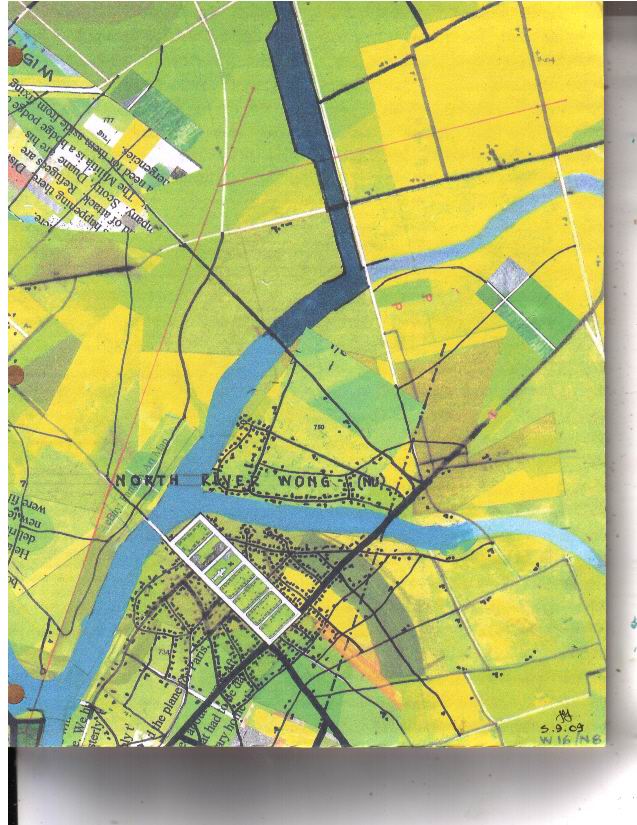
Some lovely and gentle hand-drawn maps from Emily Robertson, followed by some woodcut ones via Bob Vila.

Maps of the United States shapes comprised of their bird feathers, by kelzuki on esty, and maps shaping other forms and objects, by Matt Cusick.

Finally, some philosophical thoughts linked to inspirational images, by Maptia.

new discovery: Jerry’s map, all 50 years and 2500 plates

I’m sorry I can’t find the first link that directed me to this, but today I took a look at a site I’d tagged to revisit, Jerry’s Map.  I’m loving it. Only map-making, geodesign-inspired, cartographically-motivated, color-exhilarated people might watch all 10+ minutes of his story, on video. Me?  I’m going to watch it again.

I love how he lets the cards direct his movements, and how he’s realized how the combinations from non-adjacent tiles are just as beautiful as art, and how he manages to find his balance between following spatially-autocorrelated rules and taking artistic liberties.

using Google Maps for non-geographic representations

I just finished teaching our annual Short Spring Spatial workshops, and as usual, I had a blast updating my list of “web mapping” applications and projects. One of the categories of “maps” that continue to fascinate me are those that leverage the Google Maps API for innovative and non-conventional “spatial” thinking.  What I value here is the clever outcome that these developers don’t need to spend time/money creating a “new” platform for navigation, when the Google navigational functionality (expressed via their iconic pan and zoom icons) is all we need.

Previously I’ve known about Google’s Art Project, where you can explore the (indoor) collections of many museums around the world (click Museum View and Floor Plan to put yourself indoors) .  They’ve definitely expanded their museum coverage since last year.  I do find it curious that they’ve bothered to keep the compass functionality (which you can suppress). Perhaps someone might really want to consider whether there are patterns to the type of artwork on southern walls across different museums?  Many art museums don’t go out of their way to have large windows because they’re limiting the amount of sunlight that fades paintings.  We could systematically go through these museums and evaluate this? Maybe a project for someone’s rainy day (but not mine…).

Unfortunately, another very creative Google project using their Maps API, one that allowed you to explore fractals, is now untethered and not kept up. It was a lovely one.  And didn’t have the compass built in!

This year I have found a number of medically-oriented sites, all new to me.  These include the Zygote Body (only works with my Chrome browser), the Genome Projector, the Virtual Microscope, Brain Connectivity, and the KESM Brain Atlas (tiny mice brains).  Most of these are obviously targeted towards a particular audience for specific educational objectives, but I particularly love playing with the Zygote Body site! Clever use of overlay that’s both “horizontal” and “vertical” through the layers.  My biology-studying children found it fascinating too.  No north in these sites!

One of these days I need to teach myself how to use the API so I can have some fun. My first project will be to create Dante’s Nine Circles of Hell, Seven Terraces of Purgatory, and Nine Spheres of Paradise.  Seriously.  It’ll be a great spatial humanities project on my next rainy day.

h/t to GoogleMapsMania for many of these.

using memory and imagery to get kids to think about “place”

The last assignment for my EDUC 616 students has been to create their own “When I Was 10” maps.  I always use that age based on the the ideas about the geographies of childhood, inspired by the guidance of Edith Cobb (The Ecology of Imagination in Childhood) and Gary Nabhan and Stephen Trimble (The Geography of Childhood / Why Children Need Wild Places).  Basically, the age around 5th grade, more or less.

My students are making digital or paper versions of their maps.  They’ll likely all use planar perspectives, though in other versions of this assignment I’ve stipulated that students *must* include elements drawn from additional (oblique, frontal) perspectives as well.  Here’s a simple one on Flickr where the mapmaker used transparent areas to indicate location, then annotated.

In the digital world, we can jump down to street view for an immediate frontal perspective.  Here’s a website for a childhood walk that had the idea for narrated descriptions of such places.  Esri is promoting the idea of “story maps too;” their ideas here can readily adapted for youth-oriented projects.