geographer earns Smithsonian’s Ingenuity Award

I learned this week that Anne Kelly Knowles has won one of the Smithsonian’s American Ingenuity Awards, for her work on Visualizing Gettysburg.  Fantastic, Anne!  I love the artsy interview with her too.  It is curious that it was the Gettysburg work being heralded now, since the Smithsonian looks for work that’s taken place in the last year and this is some of Anne’s older work. She’s moved far beyond this now, to the Holocaust and to her iron work.  Stay tuned for great publications from those endeavors too.

New York State GeoSpatial Summit this week

and I’m speaking between Roger Tomlinson and Ed Parsons.  Good heavens, not too intimidating! Gulp.

What’s the value of geographic memorization? Practiced and applied, towards geoliteracy.

In my online Foundations of Spatial Thinking class, we’ve been discussing the relative merits of having students memorize places and locations. The 50 States, their capitals, countries around the world and their capital cities too. For me this type of “place name geography” is necessary but not sufficient. Yes, we should be expected to know these attributes of our own country, and (at least the general) global locations. We should begin to memorize them early, in elementary school, just the same way that by 3rd and 4th grade we are memorizing our multiplication tables, how to spell difficult words (handkerchief, neighborhood, independent, committee), and distinguishing among words commonly confused (their/there/they’re; its/it’s).

Mastering these basics are the building blocks for later “literacy” – in math, in writing, and in geographic thinking. The trick is that with our times tables and with spelling, we have countless opportunities to continue to practice and apply these basics, year after year. If we mistakenly calculate the product of 8×7, for example, we will reach the wrong solution in a math equation or hand somebody the wrong amount of change from a cash register, and we’ll be reminded of our error. When we misspell “disseminate” now, our computers will remind us by underlining the word with a squiggly red line.

But there are precious few opportunities to practice and apply the geographic knowledge that we manage to accrue during our early years. And if we never practice recalling and applying those “facts” again, they will, eventually, or even immediately, just slip from our mind, like all the other scraps of minutiae that our formal education presents us with. So isn’t it really part of a much bigger problem, really, that many later forget which one is Iraq and which one is Iran?

There are no “map” checkers built in to our computer programs.  Copy editors are paid to check for careless mistakes before written material goes to press, but there are no such skilled people employed by many media outlets. Mistakes are common (CNN and Fox both make fairly regular errors), and usually more amusing and inconvenient than damaging.  Of course it’s Apple’s maps that are the topic du jour.

So, memorization is necessary but not sufficient. Our geography education should not neglect this process, but it should also and then expect teachers, and students, to master this step and move beyond it to the applied knowledge part. Asking, understanding, and answering questions about our human and environmental interactions, without having to spend precious hours returning to the basics.

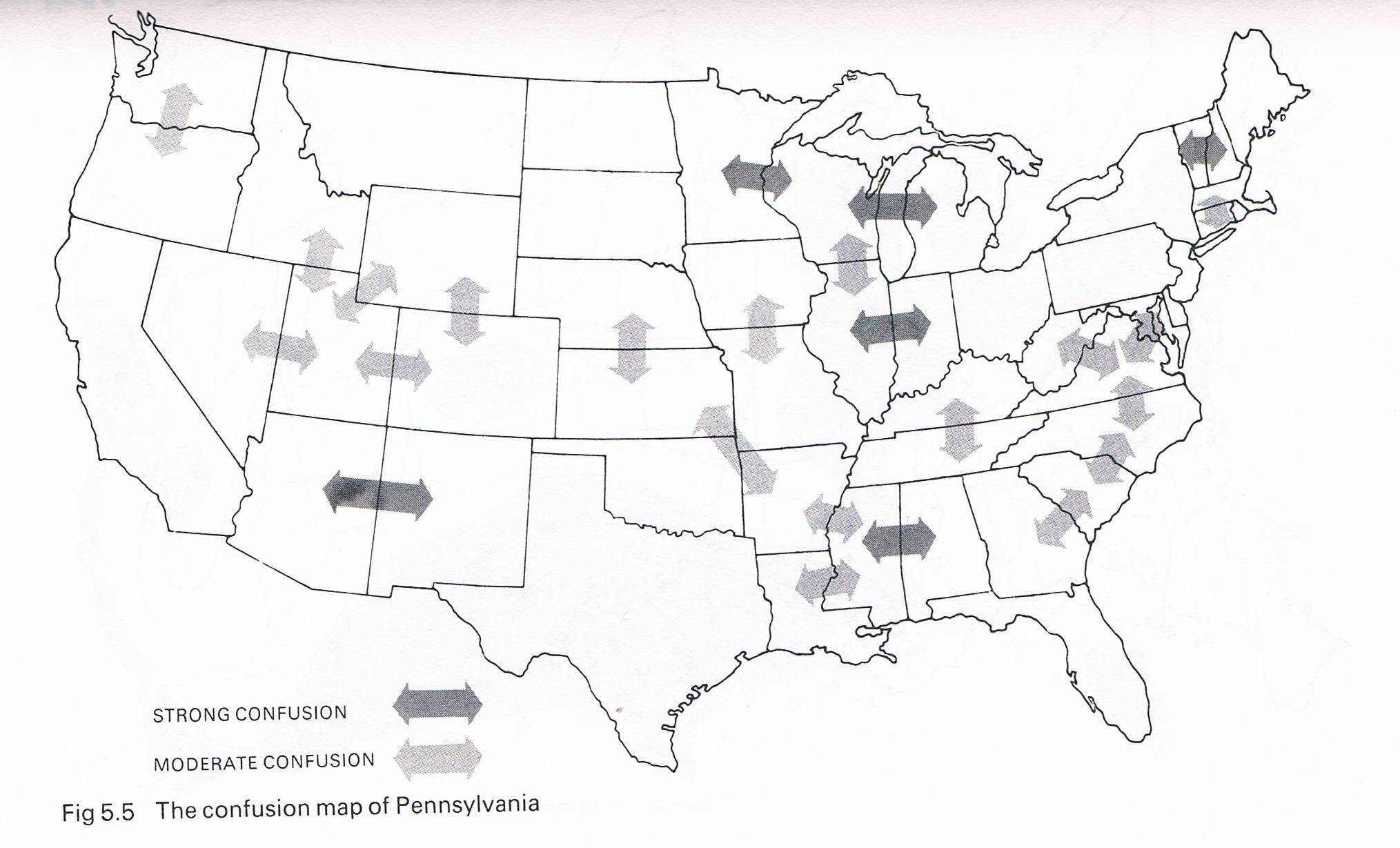
One more note on memorizing our States. Peter Gould and Rodney White, in their studies of our mental maps, found that some States are more difficult to learn than others. Shown below are the ones more likely to be confused, at least by college students in Pennsylvania in the early 1970s. Maybe these are the ones for which we just need to practice more. Just like to, two, and too.


an idea worth supporting: an innovative, well-designed, and community-sourced Food Atlas

New to me: the current project being undertaken by “guerrilla cartographers” to create a food atlas. I love the premise, I love the process, and I know I’ll like the product. Go mappers!

spatial thinking in movies

As they say, blending architecture and film. When I saw an issue it included diagrams and analysis of people’s movements too.  The Interiors Journal.  An outlet for directors and cinematographers, thinking in space.

this is what a living bridge looks like

A video describing the design, creation, and maintenance of “living” bridges in India.   True geodesign in action.  Marvelous.

h/t to Geography Education.

more examples of linking geography and history via maps, some digital

My friends at the UVa Scholar’s Lab shared with me their new Neatline project earlier this week. I don’t know much about Omeka, but I always trust these guys to do good work with a wide range of OS tools. I do like the interface, the rapid loading of georeferenced maps, and the additional interactive functionality on the main screen. If I can figure out more about this, I have a stack of projects ready to try!

In Time & Place is oriented to secondary school learning. This will be a good resource for my Spatial Literacy students, and I’ll see about modifying things for my higher ed students too.  Not sure how I wandered across this site this week. I need to click on fewer windows to make h/t’ipping easier.

Conflict History is a Google Maps mashup. I like the timeline and the thorough “info” available.  This interface and collection really highlights the disparity between how few military conflicts we’ve had on US soil versus the rest of the world, and how relatively high Europe and Asia are. Not news, but interesting to see it in this way.  H/t to Google Maps Mania.


stunning earth science designs in fabric

From my favorite fabric store, Spoonflower, check out the winners of the earth science contest.  Can’t wait to quilt with some of these!


mega-size xkcd cartoon finds a navigational platform with Esri

I love the cartoons on xkcd.  This week one was larger-than-life, requiring its own “overview” map to find one’s way around.  Frankly, after the first few moments of panning in its native environment, the amusement factor quickly faded and I lost interest.  I know I *should* enjoy taking the time just to pan,  wandering across digital space until I tumbled upon something pleasurable, but my Protestant work ethic (and spirit of capitalism?) keeps kicking in!

I wasn’t the only one who thought about how useful an overview map would be!  What a great surprise to find that this one was built and hosted on Esri’s map services!  Thank you, the zooming is just what we needed. I love it when we use our conventionally-geographic mapping interfaces for non-geographic topics, and I’ve written before about them.  This is the first time I’ve seen an Esri-built one, quickly and reactively and in good humor, and I’m glad.

Wish I had the h/t for the blog that directed me to the Esri site. Will share it when I uncover it again.

spatial AND geographic – moving the space shuttle Endeavor

While listening to this story on the radio this morning, I was struck by how much spatial and geographic planning was involved in this effort.  A great example of how such thinking is part of some people’s everyday jobs.

NPR story on moving the space shuttle Endeavor from LAX to its new home at the California Science Center, a 12 mile journey.