Matt and his dancing antics, back again

These videos  of Matt dancing around the world, in 20052006 and especially the 2008 one, have made me smile, laugh, and yearn to hold on to that sense of feeling at one with humanity. The imagery, the music from the 2008 one, the  vicarious and jealous thrill I felt at someone having the carefree opportunity to visit such places. If we only saw 2 or 3 seconds of a trip to a country, surely there were more than 2 or 3 days that we didn’t?

The 2012 version is now out, and I’m enjoying it as much as the rest.

I learned from Neatorama about the mini-history that Ethan Zuckerman had written for Matt’s videos. Intriguing was the story of the 2008 score which I’ve always adored. I shall purchase a (legal) copy of it, once my sleeping teenagers and their friends vacate the family room and allow me access to the computer with its master music library.

Linking geography to culture through language: does shape matter?

The first geography course I ever took was Political Geography, in 1987 (taught by Ron Leibowitz, who has since left the geography classroom in favor of administrative duties). The class changed the trajectory of my academic life and left a tremendous impression on me, introducing me to ideas and theories that I’d never considered before.  I remember writing a paper on Finlandization and gaining great insights in the actions of the Soviet Union, a topic of particular relevance in the ’80s.

Then sometime in the last decade I read Jared Diamond’s Guns, Germs, and Steel, and was again struck my his arguments about the role of physical geography in affecting social dynamics and development, and political infrastructure.  Plus it was great fodder for collegial discussion with our anthropology and political science friends, who respectfully disagreed with all of the premises.

Yesterday I caught up on blog reading and came across this recent Nature article about country shapes and languages.  The study suggests that long and narrow countries that span across many latitudes (like Chile) have been able to maintain greater linguistic diversity than countries broader and which cross greater longitudes (like Turkey). Of course, there are a finite number of countries suitable to test, and by treating the countries as “independent” samples in this case, we raise other issues. Every country has its own internal geographies that affect cultural development, plus individual histories and situations (or not) amongst neighbors that cannot be ignored. Plus, I agree that language may be a weak proxy for culture, though it’s a place to start.  Quantifiable measures of culture are, by definition, ambiguous and complicated, and capturing this for map use is an ongoing challenge.

Still, I appreciate the study and will keep track of it for our ongoing effort to provide evidence of geography’s import.

I continue to work on my Mapping People Visual Library Catalog, which one day may inspire new directions for social and cultural mapping.

H/t to Cultural Geography for the Nature article.

back in running mode on National Running Day

Two years ago, I completed the Rock & Roll marathon in San Diego in just over 4 hrs.  Fast forward to the present, and I’m in a state of recovery, from a year of cancer and its treatments, and 18+ months of on/off plantar fasciitis. But a few days ago I went about 2 miles with my Vibram 5-toe shoes, and today I’ll head out for another few miles in my new low-profile Brooks. My goal is to be running 1/2 marathons in a year, pain and injury free.

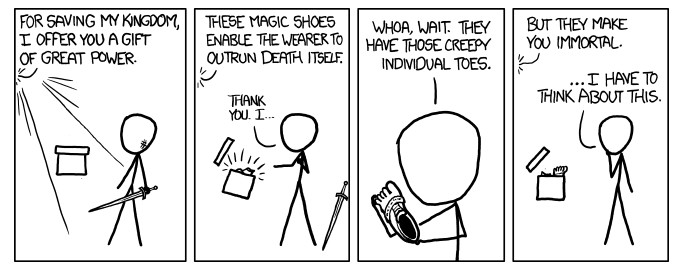
I love xkcd’s cartoons, especially on National Running Day.

using Google Maps for non-geographic representations

I just finished teaching our annual Short Spring Spatial workshops, and as usual, I had a blast updating my list of “web mapping” applications and projects. One of the categories of “maps” that continue to fascinate me are those that leverage the Google Maps API for innovative and non-conventional “spatial” thinking.  What I value here is the clever outcome that these developers don’t need to spend time/money creating a “new” platform for navigation, when the Google navigational functionality (expressed via their iconic pan and zoom icons) is all we need.

Previously I’ve known about Google’s Art Project, where you can explore the (indoor) collections of many museums around the world (click Museum View and Floor Plan to put yourself indoors) .  They’ve definitely expanded their museum coverage since last year.  I do find it curious that they’ve bothered to keep the compass functionality (which you can suppress). Perhaps someone might really want to consider whether there are patterns to the type of artwork on southern walls across different museums?  Many art museums don’t go out of their way to have large windows because they’re limiting the amount of sunlight that fades paintings.  We could systematically go through these museums and evaluate this? Maybe a project for someone’s rainy day (but not mine…).

Unfortunately, another very creative Google project using their Maps API, one that allowed you to explore fractals, is now untethered and not kept up. It was a lovely one.  And didn’t have the compass built in!

This year I have found a number of medically-oriented sites, all new to me.  These include the Zygote Body (only works with my Chrome browser), the Genome Projector, the Virtual Microscope, Brain Connectivity, and the KESM Brain Atlas (tiny mice brains).  Most of these are obviously targeted towards a particular audience for specific educational objectives, but I particularly love playing with the Zygote Body site! Clever use of overlay that’s both “horizontal” and “vertical” through the layers.  My biology-studying children found it fascinating too.  No north in these sites!

One of these days I need to teach myself how to use the API so I can have some fun. My first project will be to create Dante’s Nine Circles of Hell, Seven Terraces of Purgatory, and Nine Spheres of Paradise.  Seriously.  It’ll be a great spatial humanities project on my next rainy day.

h/t to GoogleMapsMania for many of these.

data for mapping farmers’ markets

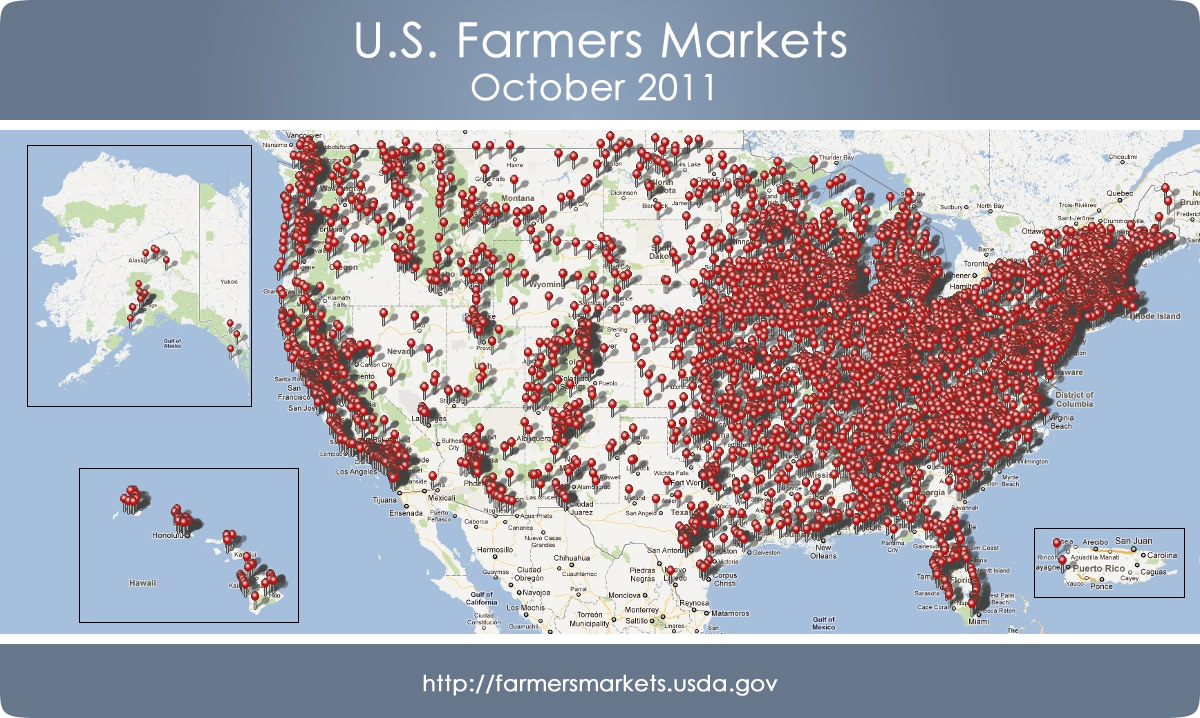
During a workshop today, I came across this USDA collection of data for farmers’ markets.  Easy to download, easy to map.  Don’t know how currently or accurately it’s maintained, but it’s enough to start with!   Somewhere this mashup image was already part of it too.

Don’t know your way around town? Drive less, wander more.

Should we be surprised that kids who get driven everywhere don’t know where they are?  And by the time they’re drivers themselves, their Google goggles will tell them when to turn left and where the post office is.  Or maybe a little voice in their ear, from their implanted device.  Sigh.

I like the way my teenage son has learned his way around town from his cross country and track team running.  So it’s not from wandering on his own, but often we’ll be out somewhere and he’ll recognize where we are (and know how many miles it is from there back to the high school).

h/t to Geography Education.

California Geographic Alliance, spatial reasoning article, new website

The California Geographic Alliance (CGA) has released its April newsletter, and in it I wrote an item about spatial reasoning.  CGA has been active on Facebook too.  Their old website still has other resources up, as they transition to the new one.  Geographic Alliances are organizations that exist in every state, though some are more actives than others.  Originally launched by National Geography and still strongly associated with them, they’re frequently a great source of professional development for geography teachers.  So is our online program in spatial literacy at the University of Redlands!

marvelous French human kaleidoscope patterns

I *love* kaleidoscopes. I remember spending hours lying on my back and twisting them over my head, towards a sunny window.  Here is an awesome “human” version, done by some clever French folks, definitely thinking spatially!  I’d not have called it an arabesque, thinking only of the ballet position, but seems the word is much broader in its design sense.  Learn something new every day!

Un, deux, trois, quatre, cinq, six, sept, huit.

h/t to Geography Education.

cool visualization for scale, size and distance

For scanning spatial scales from atomic to astronomical, check out this new Magnifying the Universe. The scrolling exponential bar in the lower right is helpful too.

h/t to Neatorama, where I always find good things.

exploring tornado analyses and data

It’s that time of year, when small towns in the Midwest make headline news for the trailers that get upturned.  One of my favorite data visualization referatory sites, ChartPorn (unfortunate name, guys) , recently posted an overview of maps and data analysis sites for info back into the mid 20th century. I explored one of these sites further and came across NOAA’s National Weather Service’s Storm Prediction Center.  This is a nice collection of GIS-ready data for those of you who want to make your own maps.