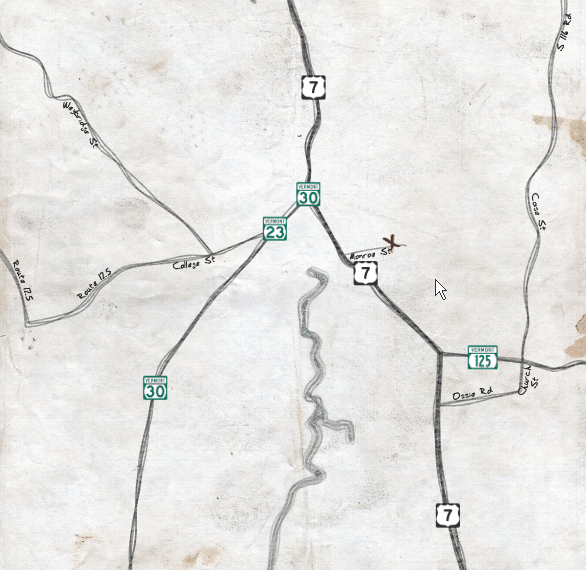
transform typical road maps to sketched ones

>
These Bing Destination maps are very cool looking.

Next Stop: Leicester, England

Leicester, Leicester, rhymes with Chester. I’m in England for the first of a 3-week Fellowship awarded by SPLINT. (Next two weeks will be in May 2010.) The 8-hr time difference between here and California complicated yesterday but now things seeming slowly more sensical in my mind. I’m staying at the home of one of the faculty members in the geography department, Pete Fisher, a man whose name I have known for many years and whose books I have on my shelves, but I didn’t even connect the dots when I sat in his kitchen yesterday!

Oh well.

Off for some breakfast and to explore the city a bit.

Yann Arthus Bertrand’s imagery

The imagery of Yann Arthus Bertrand is absolutely captivating. The man is brilliant at capturing spatial patterns and I use scanned versions of pictures from the book to teach spatial statistics. Now it’s a movie. I could watch this for the 2nd time but should probably get up and do something about the earth instead.

Finds at Where 2.0

Last week I was lucky enough to have two days at Where 2.0 in San Jose. Spent the whole plane ride up with “Do You Know the Way to San Jose” stuck in my head.

Highlights of the conference for me:

Cartifacts So far this is only for LA and NYC, but they’ll be doing more. Best part of it (apart from the nice cartography) is the small lens tool itself (the small icon in upper left of screen). That allows you to change the zoom level within the circle itself and click on different images (i.e., historic maps and other layers).

Wild Style City – Kind of wonky to use it, but when you get it to work, you can walk down the street, find a clean piece of wall, and make your own graffiti.

Flickr “neighborhoods” – Flickr is doing some cool work with its millions of geotagged images to generate new versions of “regions” and “neighborhoods.” For those of us who like to play with shapefiles, they’ve made these available too.

Andrew Turner was there to promote GeoCommons. I’ve been using GeoCommons in short mapping workshops at Redlands as it’s one of the easiest tools for quick and customizable web-based choropleths. I remember saying a couple of years ago that it was just a matter of time for someone to make an application like this.

One of the best community mapping sites I’ve ever come across, these folks from New Orleans were there to talk about how they built their maps and did their analyses – http://www.gnocdc.org/repopulation/

These panoramic images are phenomenal – http://www.360cities.net/. The two brothers who started the company gave the presentation and talked about the technology involved and how they now have 400+ photographers around the world contributing imagery. It’s not just cities…

Most phenomenal 3D imagery you can imagine – this Swedish guy from C3 Technologies gave an ad hoc demo of their product. The small video won’t do it justice, but it’s absolutely amazing in “real life” – http://en.oreilly.com/where2009/public/schedule/detail/9423. Just a few minutes long.

PhD in GIS: Listeners Respond

Our December 9th podcast
exploring PhDs in geography and GIS included a request to listeners to
share their experiences and thoughts on these advanced degrees. Many
shared their personal stories and experiences, while others involved in
education offered their insights. This roundup may prove valuable to
those considering these advanced degrees.

Mirjam Maughan, of EPA Townsville, Australia, is exploring
how a PhD might be viewed in state government
in that country. The
goal of such a degree? "My goal is to move away from being seen as a
GIS technician who pushes buttons, to a spatial analyst who can suggest
new ideas or methods in someone's project, or lead my own projects:
doing something that is 100% my interest."

Adam Spark at Kansas State is mixing
and matching his degrees
. "I'm a PhD candidate, but not in GIS.
Rather I have a graduate certificate of GIS that I've completed along
with my PhD; that's a nice complement to my PhD work in Plant
Pathology."

David DiBiase, from Penn State University, thinks it will be some
time before PhDs really take off
. "I think that the emphasis on the
vertical differentiation among credentials (e.g. PhD, MS, BS, AS) is
less important at this time than the horizontal distinction between
academic and professional degrees.

"The fact is that although more than 80% of graduate degrees are
professional (practice-oriented) master's degrees, very few
professional graduate programs focused on geographic information
science and technology are offered. I believe that PhD degrees in
GIS&T will remain rare until professional master's degrees in
GIS&T take root and prosper within colleges and universities."

Lucia Barbato, from Texas Tech University, shares the
story of gaining respect without a PhD
. "With a master's degree I'm
considered 'non-tenured staff'. … A lot of people think I have a
doctorate, but I quickly correct them. But if I did have a PhD, I
believe I would have a lot more respect from other faculty. It has
taken a while for my colleagues to recognize that they need to bring us
in to help them write the GIS component 'before' they submit a
proposal. In the early years some of our colleagues thought of our work
as an add-on to their grants and treated us more as add-on
'contractors' and not as 'co-principal investigators' (an important
distinction in recognition at a university)."

Independent consultant Grady B. Meehan, Ph.D. has done
some work to integrate GIS and business education and thinks a PhD in
GIS is a good idea
. "I developed a proposal to integrate master's
level GIS education with management education. The goal was to produce
'geo-aware' managers who could formulate clear business questions that
included a geographic component. … Furthermore, I also ran this idea
by an academic dean (who is a friend) who said if his school tried to
teach something called GIS in management, the business school dean
would tell him that business management is in his domain. From this, I
realized that many integrative, cross-disciplinary programs, (including
a business-GIS program), no matter how valuable, would run into
university political resistance, requiring much deliberation before
being implemented.

"…So, is a PhD in GIS a good idea? Yes, but its time is yet to come
in the business world. Some issues must be resolved as GIS develops in
the direction that the business world will understand. The business
world must see geography/GIS as it does applied statistics, a
discipline that offers value to business organizations. Advanced GIS
solutions require knowledge of business processes, (spatial)
statistics, geographic principles and theory, and how the technology
can be applied to provide valued business solutions."

Diana Sinton, director, Spatial Curriculum and Research, University of
Redlands, shares her take on current
geography PhDs and spatial analysis
. "I think you'll find that
there are MANY people graduating every year with a geography PhD
focusing on 'GIS and GIScience.' The types of institutions that are
members of UCGIS – http://ucgis.org/ – would have GIS concentrations
within their geography programs for sure.

"Also, the growth recognition of 'spatial analysis' as associated with
other domains/disciplines has also spawned things like this new program
– a PhD in Spatially
Integrated Social Sciences at the Univ. of Toledo
."

Re-Purposing

For any of you still paying attention to this blog, stay tuned for its transformation into something more mapping focused in the next few weeks. When that happens, I’ll retire the Argentina posts, so for those of you who want to keep those stories (that’s you, Mom), plan accordingly.

Panorama program

This Panoramas site brings out the photophile side of me.  I could spend all day spinning around the pictures.

Argentina 2, come and gone


Sorry to have left you hanging. We spent our last days in City Bell with extended goodbyes, parties at the children’s school (they were selected as the ones to lower the flag in the end-of-the-day ceremony), marveling at the amount of stuff that we’d accumulated in just 12 weeks, packing it up to give to Mari or return with us, walking around town to see things one last time, and all the while shivering because it had just turned frigid.
Eventually we did indeed make it home to California, all in one piece (or many pieces, of luggage). I have never loved living in Redlands as much as I did last Sunday afternoon, with some friends meeting us at the airport and others waiting for us at home with a lunch to share. It was warm and sunny in every meaning of the words. My most common response to the “How was Argentina?” question is, “Wonderful, with a current of inconveniences running throughout.”
Meanwhile, I can’t believe how quickly our calendars have been filling and how much mail we accumulated. Each day we must try and remember how nice it was to have simplified things for a while. For three months there we managed to go without a car. While we were away, gasoline prices here have soared to $4.35/gallon and they’re pennies higher EVERY DAY. We will change our habits. We must change our habits.
One highlight of the week has been the short phrases and sentences in Spanish that the children have been using. Even the kid who was most resistant to being there from Day 1!
Thanks for reading. This blog is likely to be re-purposed for topics more related to mapping, but I’ll be sure to let you know when the next extended trip will occur. However probably not Argentina 3…

Argentina 2, Day 76 – one more to go

Yesterday was the 29th of the month, the “Día de los Ñoquis” – or Day of the Gnocchis, if you prefer. In this part of the world, it’s a long-standing tradition to eat the doughy potato lumps on the 29th of every month, a cheap meal in anticipation of pay-day on the 30th. Or it’s a hyped scam by GMSA (Gnocchi Makers of South America), like Hallmark coming up with more ideas for holidays to celebrate. Either way, I waited in line with others to purchase from the new pasta place in town (Mamma Julia’s). Good marketing ploy on their part to have their grand opening on the 29th of a month! And a disappointment on our part that they’ve opened just as we’re leaving. Their noodles look wonderful.
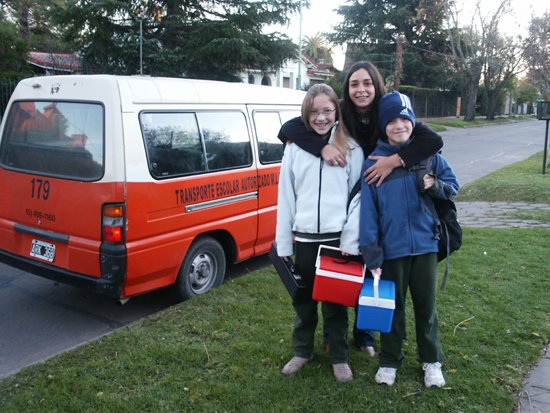
Today is the last day of school for Eric and Julia and they got a goodbye hug from their bus driver. After lunch I’ll drop off a cake in each of their classrooms as a contribution to the goodbyes. They’ll be thoroughly sugared up by bedtime since Julia will go to yet ANOTHER birthday party after school and Eric’s friends have planned a (surprise) party for him at one of their houses. No shortage of social opportunities here.


Off to pack a bag or two…

last cold trip to Buenos Aires

A busy week of packing and despedidas (goodbyes).


To complicate (or perhaps simplify?) matters, we seemed to fly from extended summer weather to bitter winter. It was -3 degrees Celcius (28-ish F?) when we woke this morning. This drafty, uninsulated house is best suited to summer rentals: the vent over the stove in the kitchen is just a hole in the wall with a small fan inserted. As I stirred Emily’s oatmeal this morning I could see my own breath. Heating that part of the house is futile, so I’ve closed it off and we’ll stick close to the living room heater today. At least by lunch time the sun will be up.


On Wednesday I took a quick trip up to Buenos Aires to see friends one last time. Elvi was able to get away from work in late afternoon and we sat in a coffee shop for a couple of hours. She’s in a deep funk about her situation in life (doesn’t want to keep working in Argentina; wishes she could land a position doing cleaning/childcare for a family in Europe (as did her sister, in Italy) or the States; knows the chances of that are slim to nil; would have to return to Peru to await a visa in any case and work options in Peru are tiny and pay a fraction of what she earns here, which is nothing anyway). I couldn’t say much other than my usual platitudes about how much her family appreciates her sending some money every month for her younger brother’s university tuition, and that he only has 2 years to go, and that she’s working for a good family and finally has temporary “working papers” here so she’s not at risk of deportation to Peru (without being able to return to Argentina), etc. Valid points on some level, but ultimately trivial responses to a profoundly complicated social and economic situation. She joked about not returning to work that afternoon, about just staying with me, or getting on the train and just keeping going. She’s reached that level of despair and hopelessness. But eventually I had to leave, and so did she, and we walked around a little and I bought her a winter coat and gave her the little money I’d gotten out of the bank earlier for her and hugged her a lot and said goodbye again.
Sigh.


Quick train over to Rachel’s house and arrived in time to help bathe Luca and Max. Splashing toddlers in a state of constant motion and oblivious to the concerns of the world. Dinner conversation with 17-yr-old daughter Jessica revolved around teenage issues: rock music concerts, body piercings, tattooes, instant messaging, reluctance to complete homework. Adolescent issues that cross all global boundaries. Their lovely cat Leonardo curled next to me all night and we kept each other warm. Hope it won’t be another five years before I see Rachel and family again, but we’ve managed at least that much since 1989 and still fall into the same close conversations when we’re together.
When we left Argentina in June of 2003, I also didn’t think we’d ever see Elvi again then. Maybe this won’t be the last time ever. Quien sabe.