>Striking Farmers

>I’m finally beginning to understand the story behind the strike that’s been going on across the country in the last few weeks. There is no shortage of opportunities to hear the news, but I guess I spend too much time sitting in my house working on a computer and connecting to the States and not enough time reading the Argentine newspapers or having conversations on the street. My step-father Fred even experienced the traffic associated with the strikers blocking a main highway but we still didn’t understand the whole story.

Now I’ve pieced together the threads with the helpful perspectives of the lady who owns the lavandería (laundromat) down the street and Mari, the woman who cleans our house. The government is imposing higher tariffs on grain exports, much of which go to China. Argentina competes with Brazil and the US for those Chinese dollars and it’s a cut-throat market. Argentina is the world’s 2nd largest corn exporter and 3rd for soybeans. President Kirchner has many ideas for how that tax revenue could be used, but many don’t think it will help those who need it most, including the (huge) agricultural sector. In protest, many farmers and transporters (truckers) went on a 16-day strike. With no truckers trucking, the shelves at stores grew emptier and emptier. Prices for meat (and milk, and other foods) are already very high here, and it’s hard to imagine an Argentine meal without meat. Last night I went to the carnecería to shop for tonight’s parilla and the butcher reminded me to get all I’d need for the weekend, as he expected to be sold out by noon today. At a market this morning, Chris said the sale of milk was limited to two boxes, sugar to two bags, and no meat could be had.

Last night the strike may have ended, good news for everyone except the cattle of the country. English accounts of the story from this Al Jazeera (!) source and the BBC report.
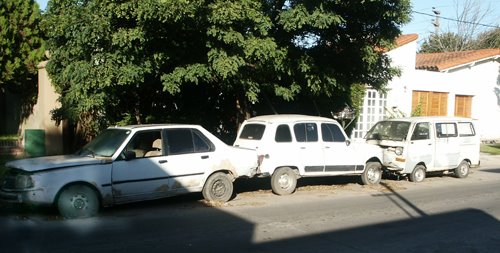
Past Their Glory Days

When I walk past these cars I’m reminded of the story of when the Chevy Nova* was first imported into some Latin American country. Sales were remarkably low, until they changed its name.
* for the handful of you who don’t speak Spanish, “no va” means “it doesn’t go” or “it doesn’t run.”

Julia’s Thoughts on School, Part 1

Mom: Julia, tell me something that you liked about school this week.

Julia: The best part of school was jump roping at recess. Sometimes they try translating the jump roping songs into English. I know one of them. It goes “Sister, sister, open and close your legs. Touch the sky, touch the ground. Hop one time and jump out.”

Mom: Is there a part of school you don’t like?

Julia: All the teachers talk in Spanish. But yesterday I figured out how to do math in Spanish. The numbers are the same.

Show Me the Body

Moist tropical weather breeds mosquitoes. I hate mosquitoes. I become an angry and determined warrior when I hear them buzzing. Sometimes I let Chris or the kids hunt them down, but there will be no peace until there is certain and verifiable death. Nothing short of delivering the body.

TV alternatives


That storm we had last week did a lot of local damage, including taking out the cable for the TV for most of the town. You may know we’ve ranted against TV in our lives for a long time now. It’s addictive junk that turns your brain to mush. Though we did crowd around our friends’ set when the Red Sox were playing, and I have been known to watch marathon sessions of Iron Chef (did anyone see the rabbit episode a few weeks ago?!)


TV here had the mixed blessing of (mostly) being in Spanish, so as the kids were watching cartoons you could almost justify it being subliminally educational, in a linguistic sense. But, easy come, easy go. In TV’s absence, the kids spend more time hanging upside down. Which is subliminally educational, in a gravitational sense.

Argentina 2, Day 10

>

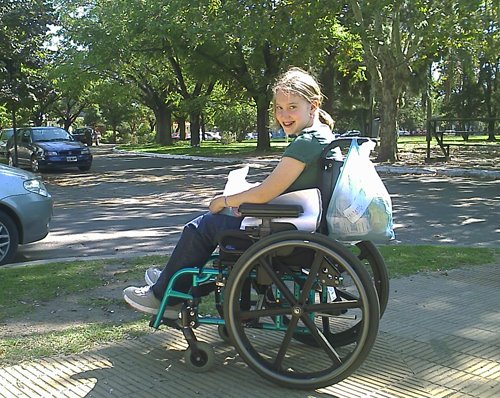
So what’s Emily doing when Eric and Julia are off at Colegio Patris? She’s doing an “independent study” to finish 8th grade. It’s a very structured form of home schooling that involves weekly assignments, emails, and phone calls with a teacher back in Redlands. It simply wasn’t feasbible to find a handicapped-accessible school for Emily, especially since the hassle of sorting it out isn’t worth the trouble for this 2.5-month-stay. Though we did manage it during Argentina 1 (back in 2003, when she was in 4th grade), we were in a much larger city and, frankly, we lucked out back then.

We haven’t established much of a routine yet, but now that the other kids leave for school each day by 8 am, we’ll get better. Since my colleagues in California don’t wake up for 4 hours after me, I sometimes do errands in the morning hours and work more in afternoons. Today Em and I walked into town to change money at the bank, buy vegetables and a battery charger (I fried our other one by not paying attention to voltage), and make photocopies. Her wheelchair works well for hauling our loot.

First Day of School


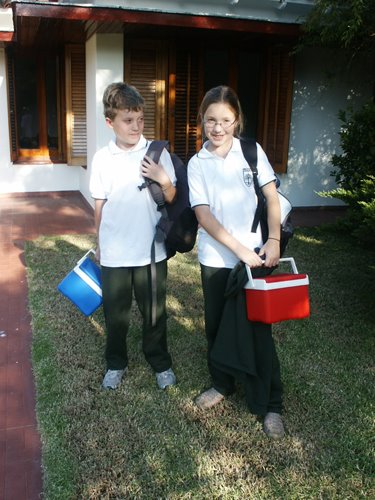
Finalmente, the children begin school! Because of the 5-day-long holiday surrounding Easter, today was the first day of school for Eric and Julia. They are enrolled at Colegio Patris, a nearby private, Catholic, bilingual school. They were quite anxious when I dropped them off this morning, though bribes of mid-week-dessert and after-school-shopping sweetened the deal. Bilingual education in Argentina means 1/2 day of English and 1/2 day in Spanish, so their morning classes are delivered exclusively in English (English language, social studies, something in science I think) and afternoon (Spanish language/literature, math, science?) is in Spanish. They managed to fudge their way through the “Catholic” bits of school, such as crossing yourself (at dinner tonight Chris taught them the good ol’ mnemonic for spectacles-testicles-wallet-watch to remember the correct sequence) and mumbling some prayers (they might have been mumbling even if they knew the words in Spanish). I’ll have them give their impressions in a few days, after the trauma has worn off a bit. Here are some pics from the end-of-day flag ceremony and them in their uniforms with their lunch boxes.

Nostalgia for Argentina I


Yesterday in Buenos Aires we also took the train up to Martinez, the suburb of Buenos Aires where we lived from January – June 2003 (hence the Argentina I monicker). It was yet another mild and sunny day and we reveled in the nostalgia of visiting our old haunts. The house we lived in on Calle Emilio Mitre, the Riverside School that the children attended (too bad someone has recently graffiteed a large W on the wall). Nobody was around to talk with (it was Easter Sunday, after all), but the places themselves were filled with memories. What a great time we had.

Easter Sunday in Argentina


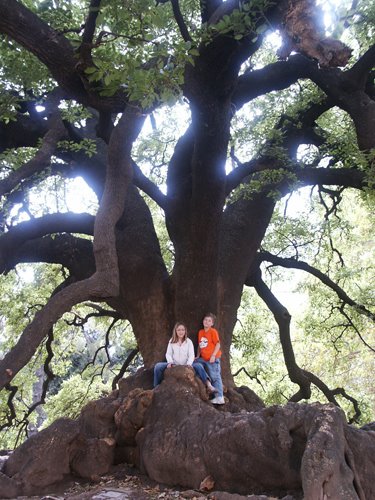
We started the day with a (paper) egg hunt in our yard then journeyed into the big city (Buenos Aires, about an hour northwest of here) for lunch (pizza and empanadas, admittedly not the traditional Easter meal in this Catholic country) and exploring parks filled with enormous trees.

>those silly French words

>11-year-old Eric: Uh, Mom, what’s the name of this thing here in the bathroom that you use to wash your butt? A beignet*?

Mom: Uh, no, Eric. That’s a bidet. And stop spraying the water everywhere!

* The only reason my son knows the word beignet is that I brought him and his sisters a box of the mix for these French doughnuts after I visited New Orleans last year.