What I Write About
Argentina cartography conferences crisis mapping daily life data & visualization design Directions Magazine education family and friends food and drink games geodesign geography GIS higher education humanities humor imagery language maps music navigation & GPS social media social sciences spatial thinking technology travel VGI web mapping
visits with friends
We had a visit yesterday with our friends Rachel Tucker and Gustavo Albanese, and their twin boys, Max and Luca. Rachel and I have been friends since 1988 when we lived together for a year in Lisbon (Portugal), both fellow English teachers. The boys are delightfully energetic 20-month-old sweethearts, and I marvel at Rachel’s ability to keep up with them! On Saturday we’ll visit the whole family (15-yr-old daughter Jessica was in school yesterday) at their home in Buenos Aires.
Posted in Argentina, family and friends
the week with Elvi
Elvi went back to her work in Buenos Aires last Sunday evening. She lives with a family in the northern suburb of Acasusso, cooking and cleaning in return for room, board, and 850 pesos/month (about $275 USD). A typical work week for a live-in housekeeper is from 9 am Monday through Saturday after lunch, with the remainder of Saturday and Sundays free. She stays with friends or family on her “free” nights. Now that she’s worked for that family for five years (since 2003, after she’d worked for us during Argentina 1), she also gets two or three weeks of “vacation” a year, and that was how she came to be at our house last week.
We had some fascinating conversations, Elvi and I. She’s 32-years-old though could pass for 18, and stands about 4’10” (we didn’t actually measure heights, but all of my kids have surpassed her since we’d last been together). She’d left Peru in 2000, looking for better employment opportunities than the dishwashing she was doing in Quito, where she’d gone when she left her hometown of Trujillo at age 14. At least three of her sisters have also come to Argentina to do childcare, housekeeping, or other domestic work. All of them send money each month back to their parents and extended family in Peru, since even the few pesos they makes here far surpass what they’d be making there. One sister now even works for a family in Italy; positions in western Europe and the US are the most highly coveted and difficult to obtain.
[This spring I’ve been co-teaching with a colleague from the Government dept at Redlands, a course on political economy in which we’d been mapping remittance flows amongst Latin American countries and the US. I’m living in one of my maps right now.]
It isn’t so often that one spends 9 days with one’s ex-housekeeper, when they’re on vacation and NOT working, and I was NOT on vacation and was working. It wasn’t hard to learn a lot about her life. Elvi’s one of those people who wakes up talking and talks all day and then talks some more until it’s time to go to bed at night. She works hard, has no home of her own, has no chance to save anything, and has few expectations for being able to significantly improve her lot. She’d like to be married and would love to be having her own children. A common sentiment for single women in their 30s. During one of our food-shopping walks around town she mentioned that sometimes she dares even think about having a baby on her own, and in my well-intentioned-but-remarkably-insensitive way I started telling her about a friend of mine who’d been debating the same thing and how it really could be possible, and Elvi turned to look at me like I was insane. Oh, right. My friend is from the States, has a steady job with benefits, makes over $50,000/yr, and has an extensive support network of nearby family and friends who can help out. Yet another thing that I’ve failed to think about much during my bourgeois and pampered life – how complicated the choice of motherhood could be to someone whose sole and small source of income requires constant physical labor and presence. For a while after that we walked in silence, which was a change.
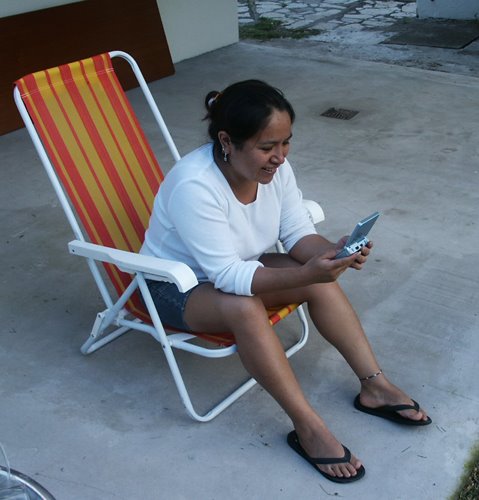
Highlights of the week included Elvi sticking to the velcro wall at the birthday party, Elvi learning how to play Bubble Breaker (on my PDA) and Pokemon on Eric’s gameboy, numerous giggling sessions with all the children, and her showing me Trujillo on Google Earth. What a wild world this is, to sit in Argentina and have Elvi navigate around Peru with me.
Posted in family and friends, social sciences
access to the outside world
>
If your glass windows swing open and your screens have little openings – within the framework of iron bars – that you reach through to open shutters that swing open, what’s a door and what’s a window?
Posted in daily life
Argentina 2, Day 24 – settling in
Seems we’re getting used to a daily routine here. I remember reading somewhere that most habits and routines (exercising, stopping nail biting, flossing, etc.) are more likely to “stick” after a period of 3 weeks. That is, if you can manage to do something for a steady 3 weeks, you reach some tipping point and you’re less likely to stop. Of course, there’s a world of 2-week quitters walking around out there…
So, we made it to through week 3 without leaving. At this point Julia’s the only one who complains, loudly and daily, about being here. She’ll be 10 on Friday and dearly wishes to be in California, or Vermont, with friends, to celebrate her birthday. She doesn’t like sharing a tiny room with her brother. She’s earned the unfortunate title of “Most Likely to be Bitten by Mosquitoes” and re-earns it daily. She’s increasingly frustrated at not being able to communicate – with any fluency – with her classmates. The names of objects and basic verbs are the first elements we learn in foreign languages, and these are inadequate when it comes to discussing nuanced, emotionally-laden, pre-adolescent topics on the playground. Chris and I joke about measuring these life experiences in “couch hours” (i.e., how many hours of psychotherapy on a couch will the person require later in life to recover from a given experience). Julia’s estimate? Immeasurable. Our estimate? I’m banking on zero, but ask us again in a few years.
Otherwise, activities of daily life continue. We don’t have a car here, so all outings require planning and time. We know our immediate neighborhood well. Eric and Julia even went solo on Sunday morning to get bread at the bakery (un kilo de pan, por favor). Fresh from the oven and pennies per serving. Within a 4-block radius we have the laundry place, the pharmacy, the fruit/vegetable store, the meat store, the chicken store (apart from big supermarkets, smaller shops specialize in either cow or chicken and never the twain shall meet), multiple bakeries and ice cream shops, and the cheese/cold cuts store. Cold cuts are fiambres in Spanish. Chris also learned recently that the word fiambre is slang for stiff, as in a cadaver. Yum. With a few more blocks, we can also get to the school supply store, the florist, the bookstore, the hardware store, the bank, the train and bus stations, and a dentist (a very nice woman whom Eric saw yesterday for a problem tooth).
It was dark when we walked home from the dentist, since the appointment had been for 6:30 pm. On the walk home we talked about why 6:30 pm is a totally normal time for Argentines to go to the dentist (the waiting room was packed when we left), the amount she charged us (70 pesos for an hour-long exam including a cleaning, a flouride treatment, a tiny x-ray, and a lesson on proper flossing techniques), why that still would be very expensive for Argentines, how much that would cost in US dollars (about $22), why that kind of appointment would have cost much more in the States, why we couldn’t afford to live here – in anything approaching the lifestyle to which we’ve become accustomed – if we weren’t paid in US dollars, and why if we got regular Argentine jobs here, we wouldn’t be paid in US dollars. It takes about 25 minutes to walk home from the dentist, long enough for meaningful conversations. Especially now that we know which houses have the really scary barking dogs that we have to avoid.

Posted in daily life
Amusement park, Argentina style
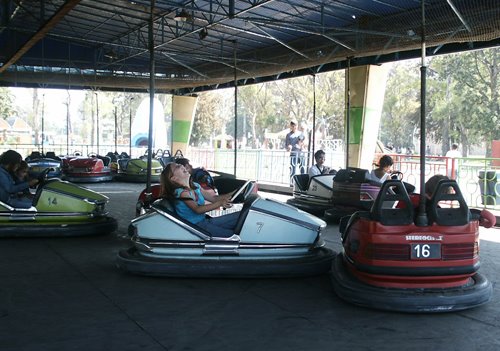
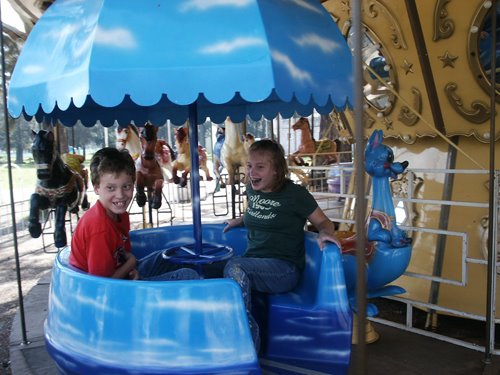
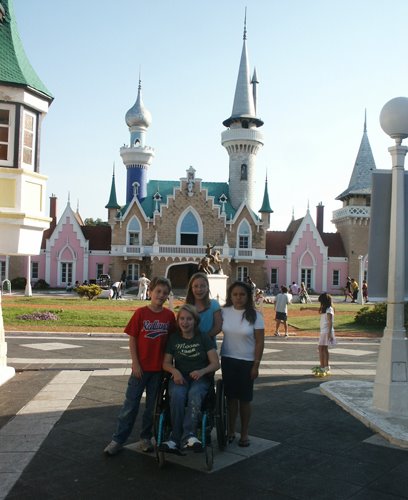
Today was spent at Republica de los Niños, a 1950s-era park very near our house. Walt Disney visited the place when it had recently opened and said it inspired him to build Disney Land. These days it’s a bit shabby around the edges, but we did get to feed llamas, ride trains, slurp ice cream, and bake in the sun. Elvi is not a big fan of spinning around upside down, or spinning around at all for that matter, so she opted out of all rides that involved leaving the surface of the Earth. Even so, the heat and just the sight of Eric and Julia (and Emily too, for that matter) on the rides made her nauseous. She wasn’t a happy camper by the end of the day. I was again grateful that the worst thing to happen was sunburn, given the lack of safety measures on all rides outside of the safety-paranoid US. Plus, spinning around upside down on ancient amusement park rides can’t be any more dangerous than driving the freeways of Southern California, statistically speaking.
p.s. Julia says, “I liked bumper cars the best. We went on them four times.”
Posted in family and friends
Bubble-Breaking Work
I ought to be more amazed, and appreciative, that I can actually do my California-based job from a remote location in Argentina. A laptop computer loaded with software, a PDA connected to an international infrastructure, electricity transformers, a high-speed internet cable in the living room, and programs like Skype and Marratech actually make it possible. I’m not working a steady 9-5 shift, but since California is four hours behind us in time zones, I do most of my production work in the mornings while people in Redlands are snug in their beds and continue to monitor their afternoon messages while I’m getting my kids to sleep many hours later.
The only hassle of any significance has been an inconvenient hick-up in the University of Redlands email system that freezes, with some consistency, when I try to “reply” to an email. It works fine when I initiate a new email to someone, but many of my messages are replies, and two times out of five when I hit the “send” button, I get only a “Forbidden” warning. Prohibido. Verboten. Interdit. What’s even more annoying is that once I’ve angered the man-behind-the-curtain-email-reply-wizard, he won’t let me access our Redlands email server – and all internet traffic is slow – for four or five minutes. So, imagine your productivity flow being ground to a halt for 4-5 minutes at least twice an hour. It’s enough to make an international telecommuter want to scream.
(Yes, I’ve already talked to IT support at Redlands about this, but they don’t know what’s going on and it’s confusing enough when I explain that no, I’m not on the UR network and I’m actually not able to stop by their offices and have them take a look at my laptop. And yes, Chris experiences the identical problem when he’s using his Redlands account too from work. And yes, it happens if we’re using webmail over Firefox too.)
Typically I use these short, limbo intervals to work offline or to answer Emily’s homework questions. But by late in the day, when my mind and writing both begin to wander, I’ve been known to grab my PDA and play 4-5 minutes of Bubble Breaker. You know the type of game, with columns/rows of colored balls and when you click on clusters of the same color they disappear, and the larger the cluster, the more points you get. Just a quick 4-5 minute fix of mind-refreshing entertainment. Then it’s back to my day job: making maps, designing classes, writing labs, organizing meetings, coordinating 6-figure proposals to government agencies, all in the name of spatial literacy.
One day last week, Mari (the woman who does some cleaning and cooking for us a few hours/day) was sweeping nearby and said something to me about the paro (the nation-wide agricultural strike that’s affecting the food supply). It was about 6:30 pm and I was in the midst of my 89th forbidden-email interval that day. With guilt I quickly put aside Bubble Breaker and we had a great and informative conversation that helped me finally understand what was happening on the street. She helped break my ignorance bubble.
What a complex structure this thing called work, and what she must wonder about my job. I type, I talk into a microphone, I type some more, I periodically grumble and walk around the house for 5-minute-stretches, then I type some more. Meanwhile, she completes tasks that are immediate and tangible. Clothes are folded, dirt is removed, dishes are washed, food is prepared. For this we pay Mari 15 pesos/hr (about $4.80/hr). For my typing and talking I earn considerably more – and a description of my work means very little to Mari, or Elvi for that matter. Yesterday I used Marratech to teach an hour-long workshop on Census data to a small group of colleagues back in California and Elvi watched in amazement and I set up my webcam and put on my microphone/headset. Then she turned her attention back to the Bubble Breaker game that I had just taught her to play on my PDA.
Posted in daily life, technology
Argentina 2, Day 18 – birthday party
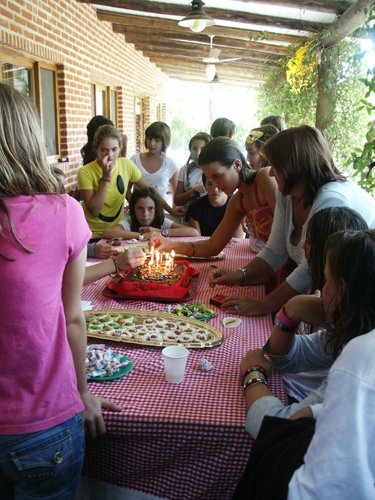
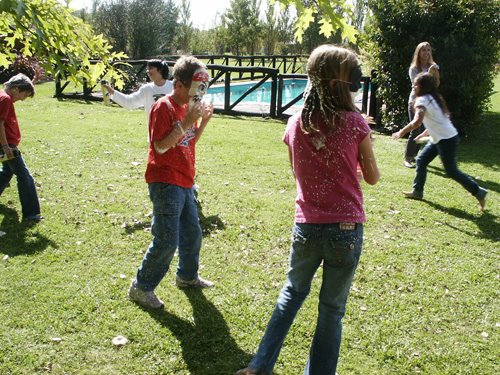
Today is a national holiday – Dia de las Malvinas (Falkland Islands). So no school for the kids, no work for Chris, and little quiet at home. We spent the afternoon with friends (Barbara and Daniel; Barbara works with Chris at CETMIC); two of their daughters were celebrating birthdays. It’s the Argentine custom to invite your entire class to your party – no hurt feelings here – so this is what a gathering of 25+ 12-yr-olds looks like. The velcro jump suits (that’s Julia on the left) were second in popularity only to the spray cans of soapy foam, labeled “artificial snow.” The 7th grade girls enjoyed combining the foam with the trampoline, while the 7th grade boys preferred to slick down their hair.
We can nominate Chris for the “white men can’t jump” award. hee hee.
Posted in Argentina, family and friends
water woes
I’m the plumber and I’ve come to fix your sink. And yes, plumbers in Argentina have difficulties with jeans riding down low too, so that their “trasero” shows.
Posted in daily life
Argentina 2, Day 16 – visiting with Elvi
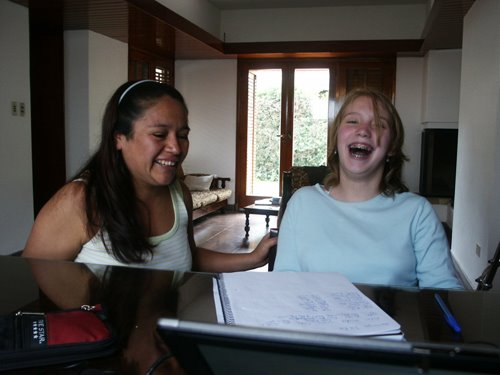
On Saturday Elvi arrived. Elvi Araujo had lived with us during Argentina I in 2003 and those of you who read my email posts then will remember how much a beloved part of our family she became. She now works for a family in Buenos Aires, cleaning and cooking, and has taken a week of vacation to spend time with our family. This morning she and Emily are giving each other English/Spanish lessons, with as much giggling as learning going on. Between Emily’s difficult-to-read handwriting and Elvi’s creative spelling (she’d only finished elementary school in Peru before she left school to work, way back when), this has been a tremendous cultural exchange. Elvi’s pronounciation of “coffee” – which comes across as “Garfield” – is guaranteed to crack up Emily every time.
Posted in family and friends
the mate tradition
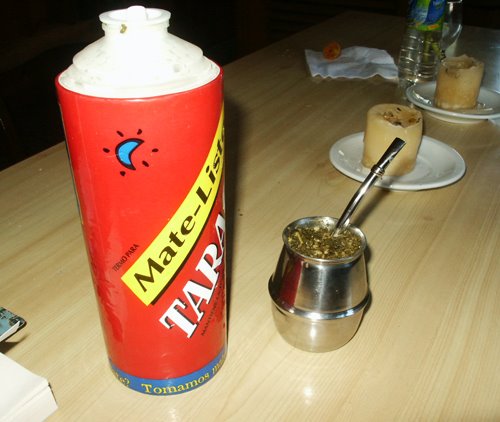
Drinking mate (with two syllables in Spanish, “mah-tay”) is a tradition throughout southern South America. It’s an herb – looks a lot like oregano – that you stuff into a container (traditinally a gourd, but now more likely wood or metal) – which is also called a “mate.” Before you fill the container you put in the metal straw (bombilla) that has a strainer/filter on the end. You pour hot water over the mate and then drink the “tea” through the straw. It does have caffeine, maybe as much as a soda ? – so it’s both a mild stimulant and effective at calming an upset stomach.
Normally it’s taken straight and it’s fairly bitter, though in some regions people add sugar or other such stuff. Chris, Julia and I enjoy drinking it, Eric tolerates it during social situations, and Emily wouldn’t touch it with a 10-foot bombilla.
EVERYONE drinks mate, young and old, rich and poor, men and women. People walk around with thermoses under their arms everywhere. Morning, noon, and night. It’s a very social experience. One person pours the water and passes it to someone, they drink and return to the pourer who refills and passes to the next person, and so on. Burning hot metal straws don’t allow for many communal germs, or so we allow ourselves to believe. What’s a little spit among friends anyway?
Posted in food and drink